Synthesis and Structural Characterization of Zinc Oxide Nanoparticles for Optoelectronic
DOI:
https://doi.org/10.65521/apl.v7i1.4269Keywords:
Abstract
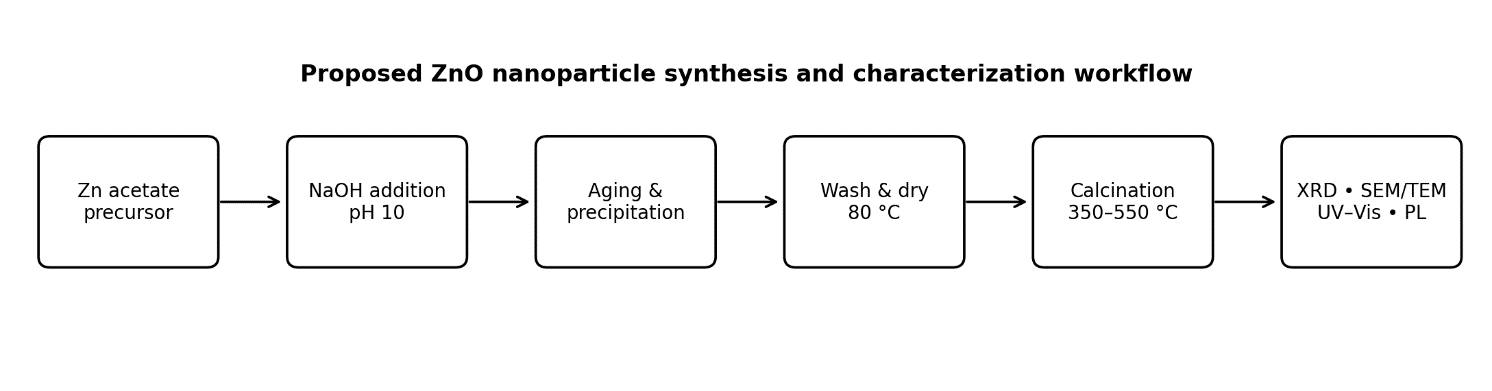
Zinc oxide (ZnO) is a direct wide-band-gap semiconductor whose nanoscale form combines chemical stability, optical transparency, ultraviolet sensitivity, and strong excitonic behavior. This methodology paper presents a compact experimental framework for synthesizing ZnO nanoparticles by a zinc-acetate/alkali sol–gel–precipitation route and for correlating processing conditions with structural and optoelectronic properties. Zinc acetate dihydrate is used as the Zn2+ precursor and sodium hydroxide as the hydrolyzing agent. The resulting precipitate is washed, dried, and calcined at 350, 450, and 550 °C to examine temperature-dependent crystallization. Phase purity and crystallite size are evaluated by X-ray diffraction (XRD), morphology by scanning or transmission electron microscopy, optical absorption by UV–visible spectroscopy, and radiative defects by photoluminescence (PL). The analysis focuses on the hexagonal wurtzite phase, nanoscale crystallite growth, absorption-edge shifts, optical band gap, and the relative intensity of near-band-edge and visible defect emission. A literature-consistent validation dataset predicts that increasing calcination temperature improves crystallinity and enlarges the crystallite size while slightly reducing the apparent optical band gap toward bulk ZnO. The combined methodology is suitable for screening ZnO nanopowders intended for ultraviolet photodetectors, transparent optoelectronic layers, light-emitting structures, and related semiconductor devices.