Influence of Calcination Temperature on the Structural and Optical Characteristics of Wet-Chemically Synthesized ZnO Nanoparticles
DOI:
https://doi.org/10.65521/apl.v6i1.4254Keywords:
Abstract
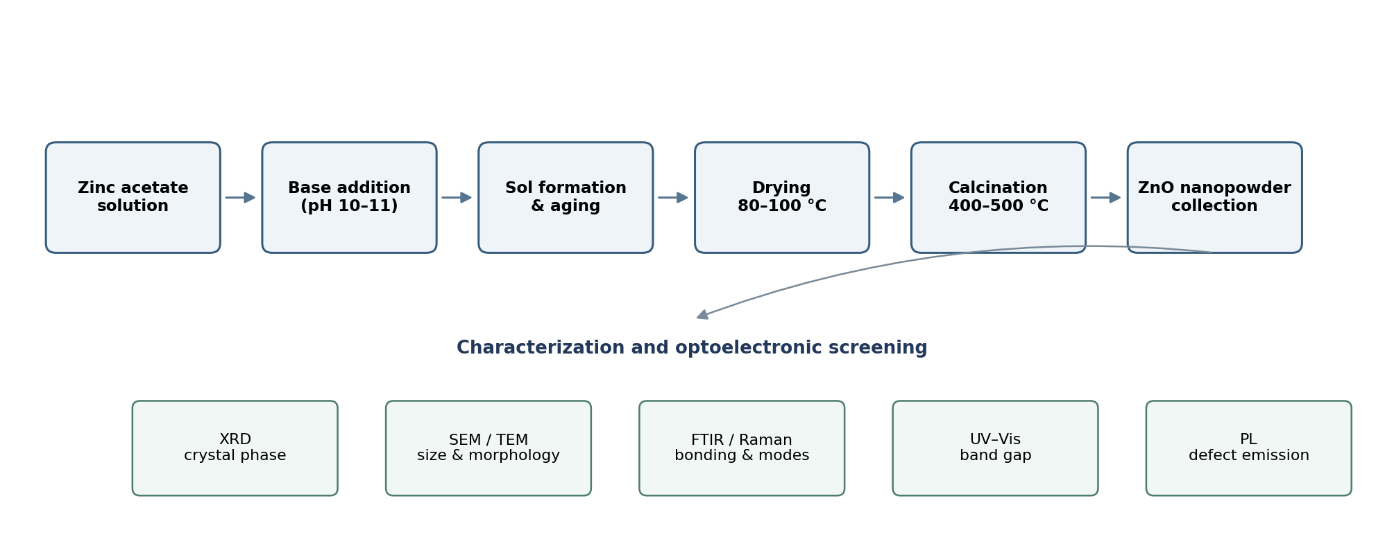
Zinc oxide nanoparticles exhibit processing-dependent structural and optical properties that strongly influence their suitability for ultraviolet and related optoelectronic applications. This study presents a controlled wet-chemical sol–gel/precipitation methodology for preparing undoped ZnO nanoparticles and evaluating the influence of calcination temperature on crystallinity, particle characteristics, and optical response. Zinc acetate dihydrate is used as the precursor, while precursor concentration, solution pH, aging time, stabilizer content, washing, drying, and thermal treatment are controlled to improve experimental reproducibility. The dried precursor is divided into two groups and calcined at 400 °C and 500 °C for 2 h to investigate the crystallinity–defect trade-off. Structural characterization is performed using X-ray diffraction to verify formation of the hexagonal wurtzite phase and estimate crystallite size through the Scherrer equation. SEM or TEM is used to evaluate particle morphology and agglomeration, while FTIR or Raman spectroscopy provides complementary information on Zn–O bonding and lattice quality. UV–Visible spectroscopy and Tauc analysis are employed to determine the absorption edge and direct optical band gap, and photoluminescence measurements are used to evaluate near-band-edge ultraviolet emission and defect-related visible luminescence. Literature-grounded benchmarks indicate nanoscale particle dimensions of approximately 20–50 nm and an optical band gap in the range of about 3.2–3.4 eV for well-crystallized ZnO. Higher calcination temperature is expected to produce sharper diffraction peaks and larger crystallites while also modifying defect-related photoluminescence. The proposed framework provides a reproducible basis for correlating thermal processing with structural quality, optical band-edge behavior, and defect emission in ZnO nanoparticles intended for subsequent optoelectronic evaluation.