Synthesis and Characterization of ZnO Nanostructures for Sensor Devices
DOI:
https://doi.org/10.65521/apl.v5i1.4237Keywords:
Abstract
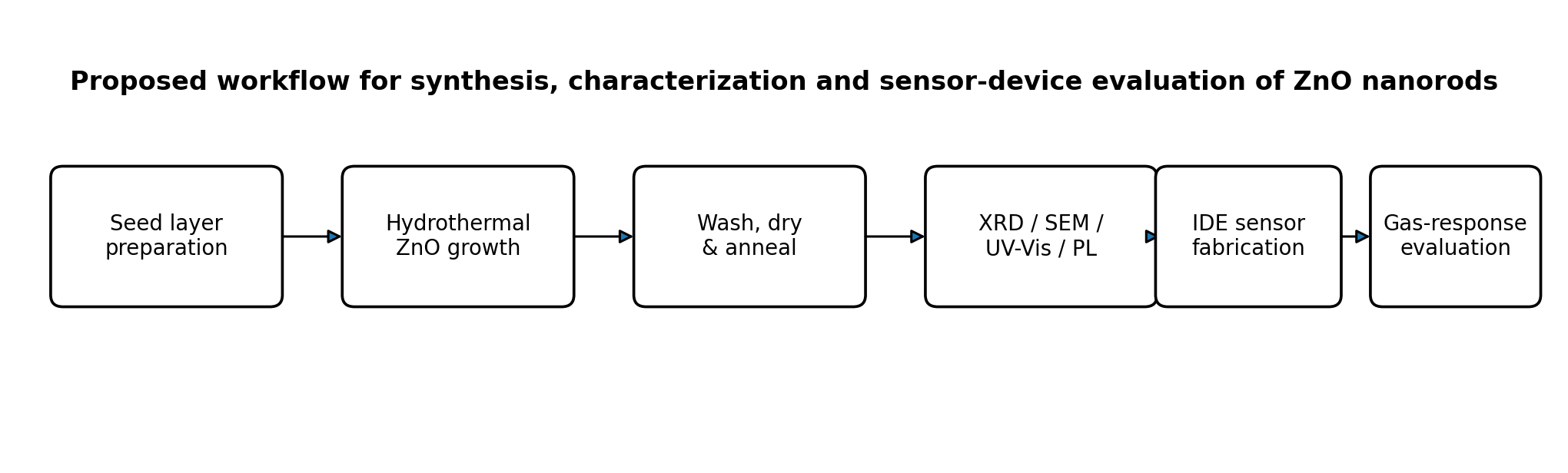
Zinc oxide (ZnO) is a wide-band-gap n-type semiconductor whose high surface-to-volume ratio, chemical stability, defect-sensitive conductivity, optical response and compatibility with low-cost solution processing make it a strong platform for miniaturized sensors. This methodology paper proposes a reproducible route for synthesizing vertically oriented ZnO nanorods and evaluating their suitability as resistive sensor elements. A seeded hydrothermal method is selected because it enables growth below 100 °C, avoids vacuum equipment and permits direct deposition on insulating or electrode-patterned substrates. The experimental design uses zinc nitrate hexahydrate and hexamethylenetetramine (HMTA) as equimolar growth precursors, followed by washing, controlled annealing and multitechnique characterization using X-ray diffraction (XRD), scanning electron microscopy (SEM), energy-dispersive X-ray spectroscopy (EDS), UV-visible spectroscopy and photoluminescence (PL). For device evaluation, the nanorod layer is integrated with interdigitated electrodes and exposed to calibrated ethanol concentrations as a model reducing gas while resistance, response, recovery, selectivity and repeatability are measured as functions of concentration and operating temperature. The approach is grounded in literature available up to 2016 and is designed to separate structure–property relationships from fabrication variability. Expected outcomes include single-phase wurtzite ZnO, preferential c-axis growth, nanoscale rod diameters, a near-band-edge optical response, and a measurable resistance decrease in the presence of ethanol. The proposed protocol is adaptable to NO2, H2S, UV and biosensing formats and provides a practical framework for linking synthesis conditions, surface morphology and sensor performance without relying on expensive fabrication facilities.