Synthesis and Characterization of ZnO Nanoparticles for Optoelectronic Applications
DOI:
https://doi.org/10.65521/apl.v4i1.4196Keywords:
Abstract
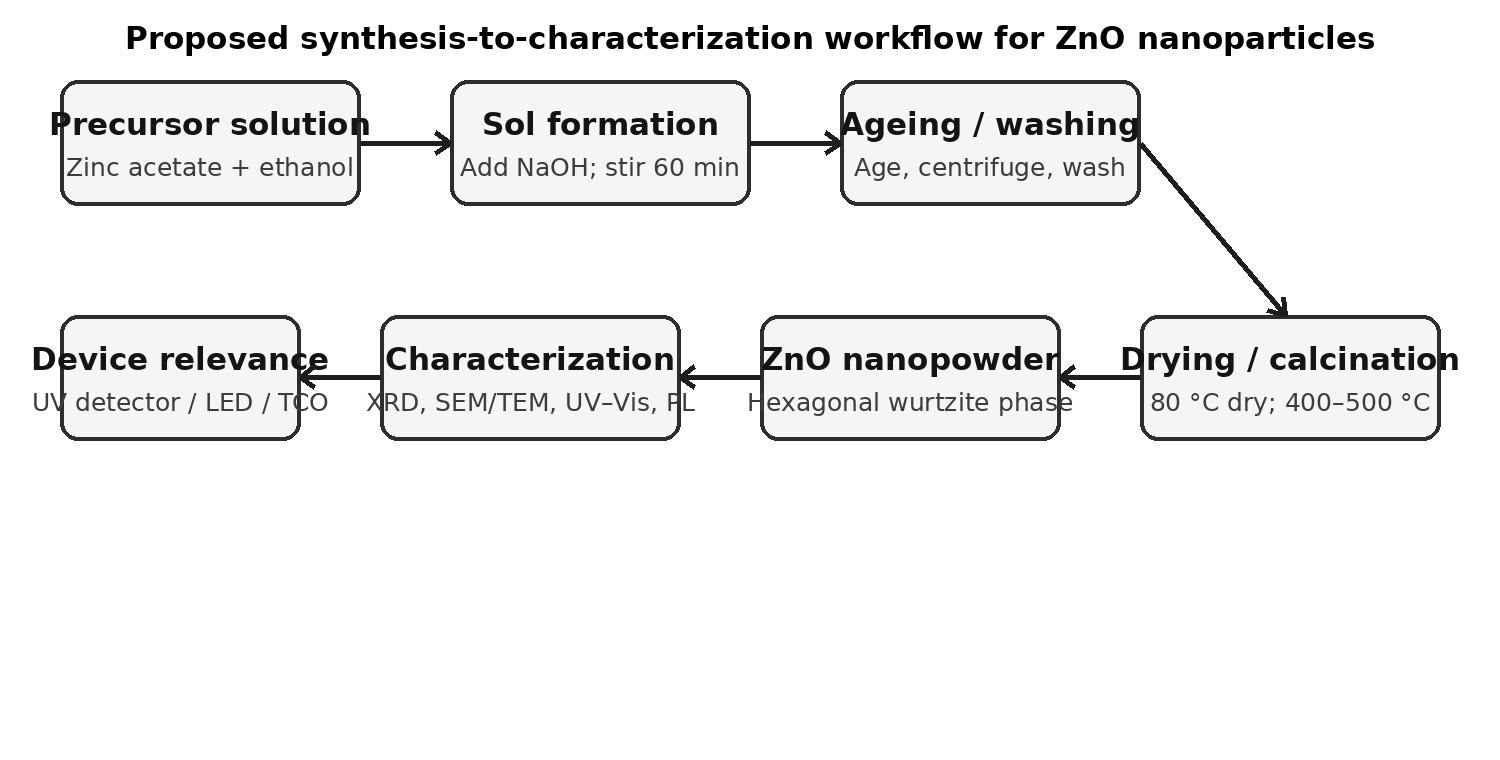
Zinc oxide (ZnO) is a wide-band-gap semiconductor whose high exciton binding energy, optical transparency, defect-sensitive luminescence and compatibility with low-cost wet-chemical processing make it attractive for ultraviolet photodetectors, light-emitting structures, transparent electronics and photovoltaic interfaces. This methodology paper proposes a reproducible sol-gel/precipitation route for synthesizing ZnO nanoparticles from zinc acetate, followed by structural, morphological, optical, luminescence and electrical characterization. The procedure emphasizes controlled precursor concentration, alkaline hydrolysis, ageing, washing and calcination because these parameters strongly influence crystallite size, defect chemistry and optical band gap. X-ray diffraction (XRD) is used to verify the hexagonal wurtzite phase and estimate crystallite size; scanning/transmission electron microscopy (SEM/TEM) is used for morphology and particle-size assessment; UV-Visible spectroscopy is used to determine the absorption edge and optical band gap; photoluminescence (PL) is used to distinguish near-band-edge emission from defect-related visible emission; and impedance/current-voltage measurements are proposed for electronic response. Literature published no later than 2015 indicates that chemically synthesized ZnO commonly exhibits nanoscale wurtzite crystallites, a near-UV absorption edge, room-temperature excitonic emission and processing-dependent defect luminescence. The methodology therefore provides a compact framework for linking synthesis conditions to optoelectronic quality while avoiding unsupported claims of device performance.