Optical and Structural Characterization of Rare Earth Doped Phosphor Materials
DOI:
https://doi.org/10.65521/apl.v5i1.4244Keywords:
Abstract
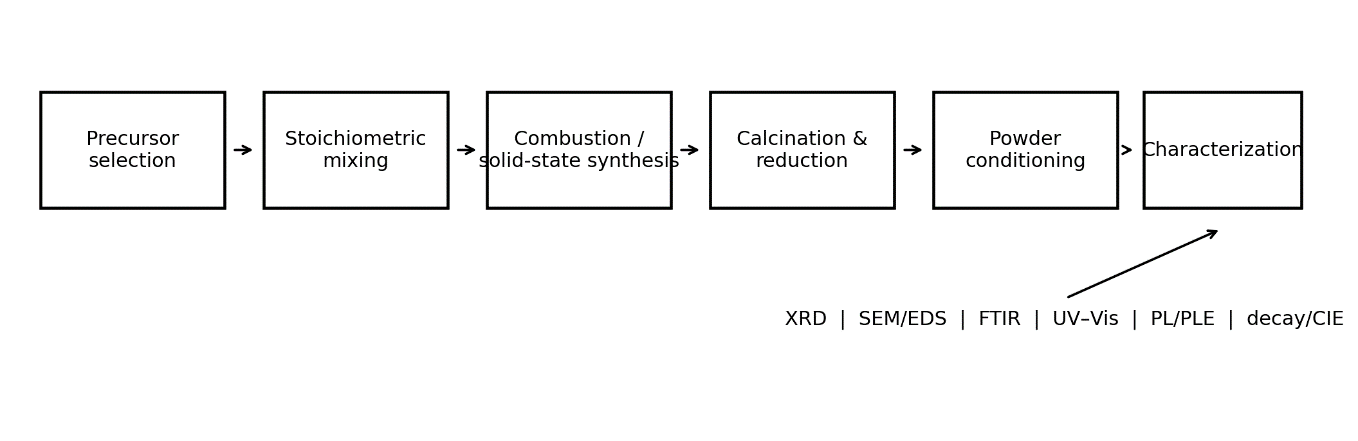
Rare-earth-doped phosphors are functional inorganic materials whose optical response is controlled jointly by the crystal structure of the host, the oxidation state and site symmetry of the activator, dopant concentration, defects, and thermal history. This methodology paper presents a compact and reproducible protocol for correlating structural characteristics with optical performance in oxide phosphors, using europium- and dysprosium-activated strontium aluminate as a representative system while retaining applicability to yttria, borate, molybdate, phosphate, and titanate hosts. The proposed procedure combines controlled powder synthesis with X-ray diffraction (XRD), scanning electron microscopy/energy-dispersive spectroscopy (SEM/EDS), Fourier-transform infrared spectroscopy (FTIR), UV–visible spectroscopy, photoluminescence excitation/emission (PLE/PL), decay analysis, and CIE chromaticity calculations. XRD establishes phase purity, lattice response, and crystallite size; microscopy verifies particle morphology and dopant distribution; spectroscopic measurements identify host absorption and characteristic 4f–4f or 4f–5d transitions. Literature up to 2016 shows that improved crystallinity can enhance Eu³⁺ emission, Dy³⁺ commonly produces blue–yellow emission, and SrAl₂O₄:Eu²⁺,Dy³⁺ exhibits broad green emission with persistent luminescence. The methodology emphasizes concentration-series measurements and explicit identification of concentration quenching rather than reporting a single composition. Representative outcomes are stated as literature-consistent expectations and are not presented as newly measured data. The framework is suitable for laboratories seeking a concise protocol for phosphor screening, structure–property analysis, and optimization for lighting, display, sensing, or persistent-luminescence applications.