A Study on Thermoluminescence Characteristics of Rare-Earth Doped Phosphors
DOI:
https://doi.org/10.65521/apl.v7i1.4267Keywords:
Abstract
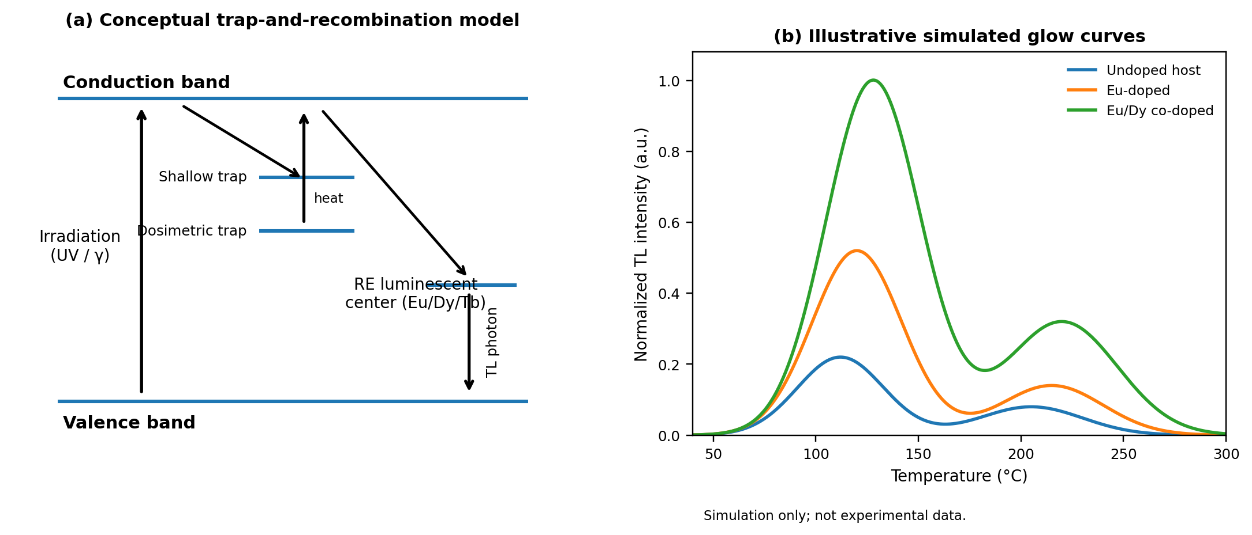
Thermoluminescence (TL) is a thermally stimulated light-emission process in which charge carriers created by prior irradiation are stored at metastable defects and released during controlled heating. Rare-earth ions are particularly useful in phosphor hosts because they can create or modify trapping states and can also act as efficient radiative recombination centers. This methodology paper proposes a systematic framework for studying the TL characteristics of rare-earth-doped phosphors, using alkaline-earth aluminate phosphors as the principal model system and published work up to 2018 as the evidence base. The study design integrates controlled synthesis, X-ray diffraction, morphology analysis, photoluminescence, ultraviolet and gamma irradiation, glow-curve acquisition, dose-response measurements, fading tests, and kinetic analysis. Eu2+ is treated primarily as an emission center, while Dy3+ and related rare-earth co-dopants are evaluated for their influence on trap density and trap depth. Peak-shape analysis and computerized glow-curve deconvolution are proposed to estimate activation energy, frequency factor, and kinetic order. An illustrative simulation is included to show how increased rare-earth-assisted trapping can enhance and reshape a TL glow curve; the simulated values are not presented as experimental measurements. The methodology is intended to support reproducible comparison of phosphor composition, irradiation dose, heating rate, and thermal treatment, and to identify compositions with strong, stable, and approximately linear TL responses suitable for dosimetry, persistent-luminescence studies, and radiation-sensing applications.