Theoretical Analysis of Dark Matter Distribution in Galactic Halos
DOI:
https://doi.org/10.65521/apl.v10i1.4457Keywords:
Abstract
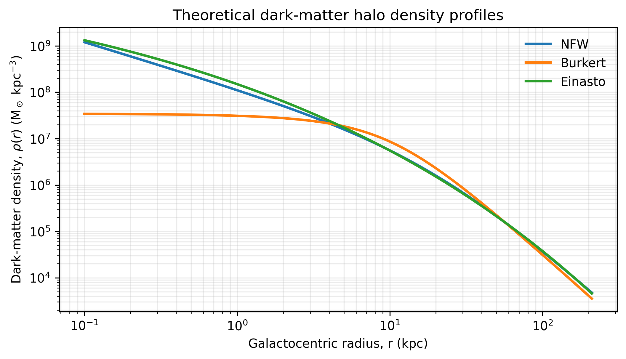
Dark matter halos dominate the gravitating mass of galaxies outside their luminous regions, yet the radial form of the halo density remains one of the central theoretical problems in galaxy dynamics. This methodology paper develops a controlled analytical comparison of three widely used spherical halo descriptions: the Navarro-Frenk-White (NFW), Burkert, and Einasto profiles. Each profile is normalized to an identical Milky-Way-scale virial mass, M200 = 10^12 solar masses, within r200 = 210 kpc so that differences in the inner halo arise from profile shape rather than total mass. The theoretical workflow evaluates density, enclosed mass, circular velocity, and logarithmic density slope over 0.1-210 kpc, with sensitivity tests on concentration, core radius, and Einasto shape index. Model-derived results show that the NFW and Einasto prescriptions remain centrally concentrated, whereas the Burkert model develops a nearly constant-density inner core. Despite marked differences at approximately 1 kpc, the profiles become more similar over intermediate galactic radii after common-mass normalization. The analysis demonstrates why high-resolution inner-galaxy kinematics are especially discriminating and provides a reproducible framework for testing halo structure without presenting illustrative calculations as observational measurements.