Theoretical Analysis of Dark Matter Distribution in Galactic Halo Structures
DOI:
https://doi.org/10.65521/apl.v9i1.4281Keywords:
Abstract
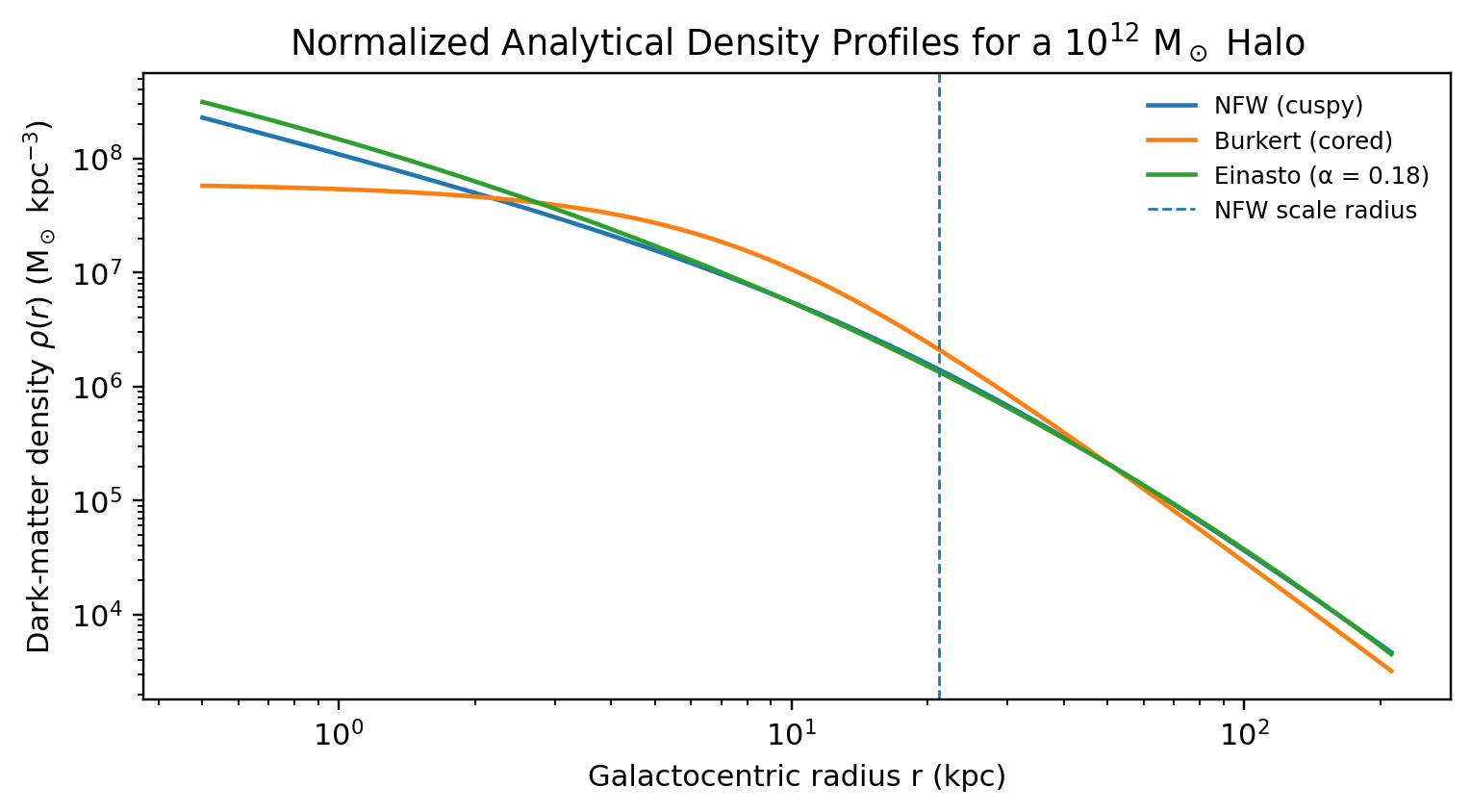
Dark matter dominates the gravitational mass budget of galactic halos and therefore controls the formation, rotation, and long-term dynamical stability of galaxies. This methodology paper presents a theoretical framework for analysing dark-matter distributions through analytical halo density models. The Navarro-Frenk-White (NFW), Burkert, and Einasto profiles are normalized to a common virial mass and compared using radial density, enclosed mass, logarithmic density slope, and circular velocity. A fiducial Milky-Way-mass halo of M200 = 10^12 M_sun is adopted under a flat Lambda-CDM cosmology consistent with Planck-era parameters. The resulting calculations show that cuspy and cored prescriptions can agree well at intermediate and outer halo radii while predicting substantially different densities and circular velocities in the inner few kiloparsecs. This behaviour illustrates why the central structure of dwarf and spiral galaxies remains a sensitive test of the combined effects of collisionless cold dark matter, baryonic feedback, and halo assembly history. The framework is deliberately analytical and reproducible, making it suitable as a baseline methodology for later comparison with observed rotation curves or cosmological simulation outputs.