Numerical Analysis of Heat Transfer Characteristics in Magnetohydrodynamic Fluid Flows
DOI:
https://doi.org/10.65521/apl.v8i1.4270Keywords:
Abstract
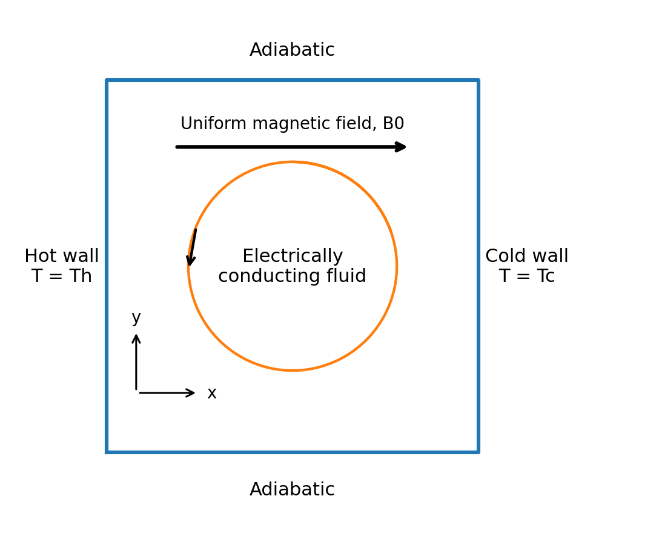
This methodology paper develops a reproducible numerical framework for studying heat transfer in steady, laminar magnetohydrodynamic (MHD) convection of an electrically conducting Newtonian fluid. A two-dimensional differentially heated square enclosure is selected as the benchmark configuration because it isolates the competing actions of buoyancy, viscous diffusion, thermal diffusion, and Lorentz-force damping. The governing continuity, momentum, and energy equations are nondimensionalized using the cavity length and temperature difference, yielding the Rayleigh (Ra), Prandtl (Pr), and Hartmann (Ha) numbers as the principal control parameters. The equations are discretized on a structured grid using a finite-volume/finite-difference framework with second-order diffusion terms, bounded convection treatment, and iterative pressure-velocity coupling. Grid independence and convergence criteria are incorporated into the workflow before the heat-transfer metric, the average Nusselt number, is evaluated. The planned parameter sweeps cover Ra = 10^4-10^6 and Ha = 0-100 at Pr = 0.71. The numerical sensitivity analysis shows the expected transition from buoyancy-dominated circulation to conduction-dominated transport as magnetic strength increases. The methodology is consistent with published MHD enclosure studies available up to 2019 and is suitable for extension to liquid-metal cooling, crystal growth, thermal processing, and magnetically controlled heat-transfer systems