Numerical Simulation of Plasma Confinement in Magnetic Fusion Reactors
DOI:
https://doi.org/10.65521/apl.v9i1.4276Keywords:
Abstract
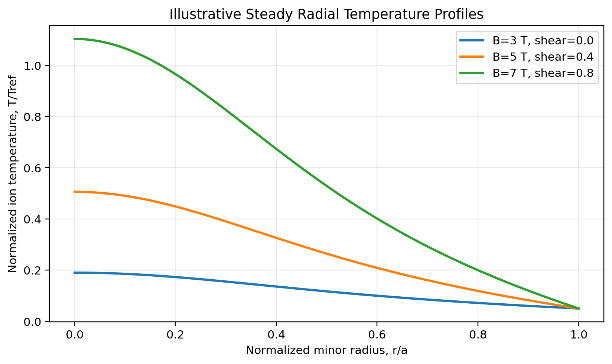
Magnetic-confinement fusion requires plasma temperatures high enough for thermonuclear reactions while minimizing radial energy and particle losses. Because direct experimental exploration of every operating regime is expensive and limited by machine availability, numerical simulation is a central tool for predicting confinement behavior and testing transport hypotheses. This methodology paper develops a reproducible reduced numerical framework for studying plasma confinement in a tokamak-like magnetic fusion reactor. The approach combines a one-dimensional radial energy-transport equation, a parameterized effective diffusivity representing turbulence-driven transport, finite-volume discretization, and systematic sweeps of magnetic-field strength and flow-shear level. The numerical procedure is informed by the development of gyrokinetic turbulence simulation, zonal-flow physics, and modern transport modeling reported in the fusion literature up to 2020. Illustrative calculations show that lowering the effective turbulent diffusivity produces more peaked temperature profiles and a larger energy-confinement proxy. In the representative sweep, the normalized confinement proxy increases from about 0.86 for a low-field, unsheared case to about 3.37 for the highest-field, strongest-shear case. These results are not presented as an ITER discharge prediction; rather, they demonstrate a transparent methodology that can be extended to experimental equilibria, kinetic closures, electromagnetic fluctuations, and high-fidelity gyrokinetic solvers. The framework is suitable for methodological studies in which numerical verification, parameter sensitivity, and physically interpretable confinement trends are required.