Numerical Simulation of Plasma Dynamics in Controlled Fusion Reactors
DOI:
https://doi.org/10.65521/apl.v10i1.4451Keywords:
Abstract
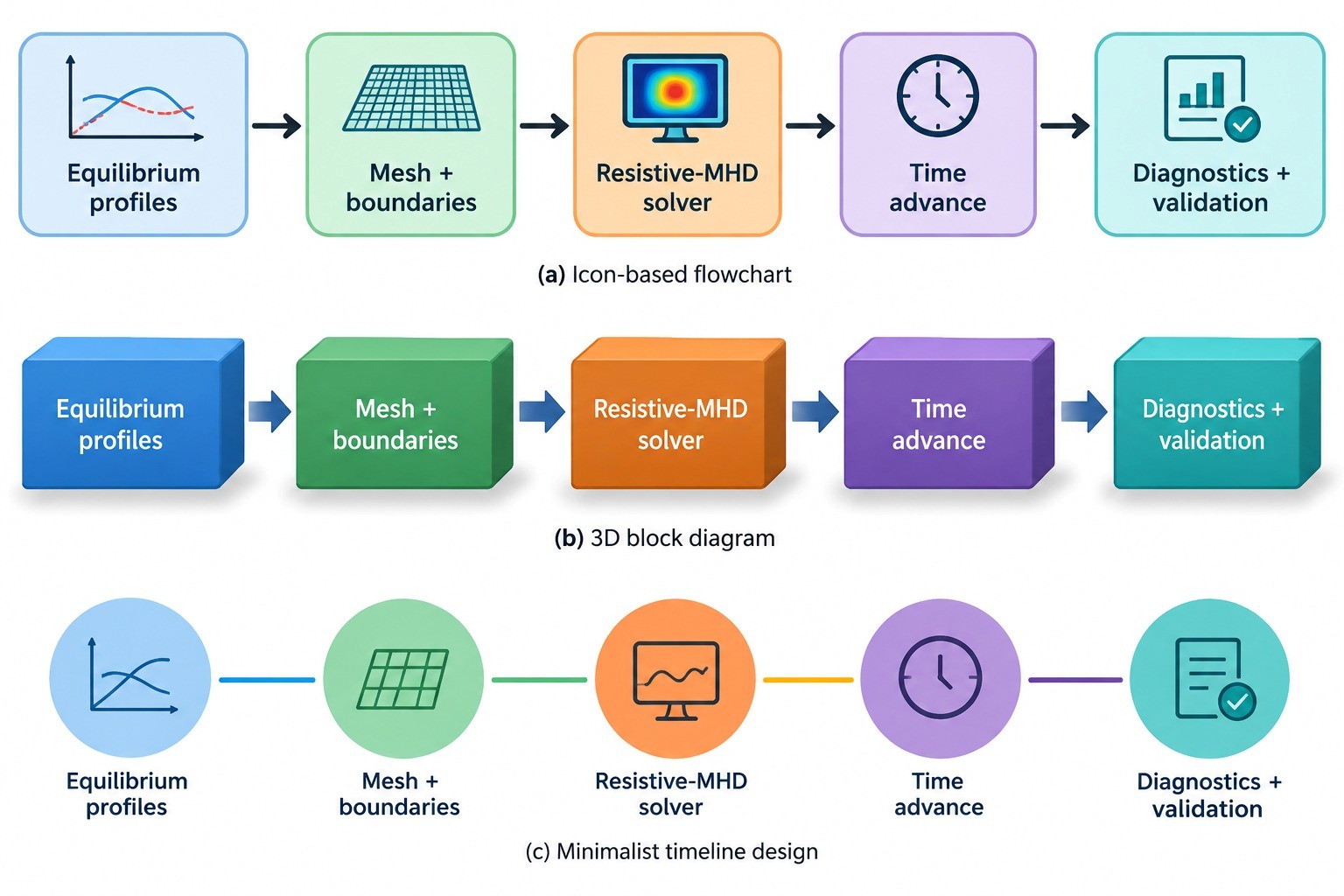
Numerical modelling is essential for studying the nonlinear, multiscale behaviour of magnetically confined plasmas because many instability, transport, and disruption processes occur on time and length scales that are difficult to isolate experimentally. This paper presents a compact methodology for simulating plasma dynamics in a tokamak-like controlled-fusion reactor using a resistive magnetohydrodynamic (MHD) framework supplemented by anisotropic heat transport. The workflow includes equilibrium initialization, finite-element or finite-volume spatial discretization, semi-implicit time integration, divergence control, grid-convergence testing, and physics-based diagnostics. The methodology is consistent with established nonlinear MHD approaches used in NIMROD, JOREK, and M3D-C1 [1-3,7]. A normalized reduced transport-instability benchmark is also evaluated to demonstrate numerical convergence without claiming reactor-specific predictive accuracy. The benchmark shows growth and saturation of a perturbation, increased cross-field transport, and a converged thermal-energy-loss proxy. The approach provides a reproducible foundation for extending simulations toward edge-localized modes, tearing modes, thermal quenches, and plasma-control studies in realistic fusion geometries