Effects of Magnetic Field on Charge Carrier Transport in Semiconductor Devices
DOI:
https://doi.org/10.65521/apl.v7i1.4265Keywords:
Abstract
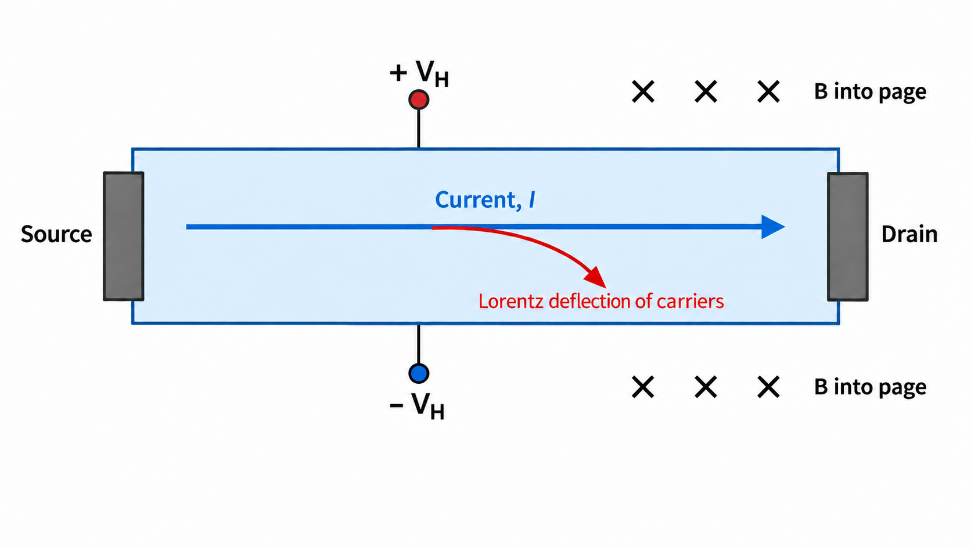
This methodology paper presents a compact framework for analyzing how an externally applied magnetic field modifies charge-carrier transport in semiconductor devices. The study combines a semiclassical Drude–Boltzmann conductivity-tensor model, Hall-effect analysis, a two-carrier extension, and literature-guided interpretation of geometric, inhomogeneity-driven, and quantum magnetoresistance. The magnetic-field response is evaluated through longitudinal conductivity, Hall conductivity, Hall angle, resistivity, and magnetoresistance as functions of carrier mobility, carrier density, compensation ratio, and field strength. Representative parameter sets are used for Si-like, GaAs-like, and InSb-like transport to demonstrate the sensitivity of device behavior to mobility. The model shows that magnetic deflection is weak in low-mobility silicon at moderate fields but becomes pronounced in high-mobility III–V semiconductors; at 1 T, the normalized longitudinal conductivity falls to approximately 58% for a GaAs-like mobility and about 6% for an InSb-like mobility. In an ideal one-carrier homogeneous Drude conductor this conductivity redistribution does not by itself produce longitudinal magnetoresistance, so measurable resistance changes require multicarrier transport, scattering-time dispersion, device geometry, inhomogeneity, space-charge effects, or quantum mechanisms. The proposed workflow is suitable for Hall devices, magnetic sensors, semiconductor/metal hybrid structures, and comparative magneto transport simulations while remaining consistent with literature published through 2018.