Study of Magnetic Phase Transitions in Rare-Earth Compounds
DOI:
https://doi.org/10.65521/apl.v10i1.4454Keywords:
Abstract
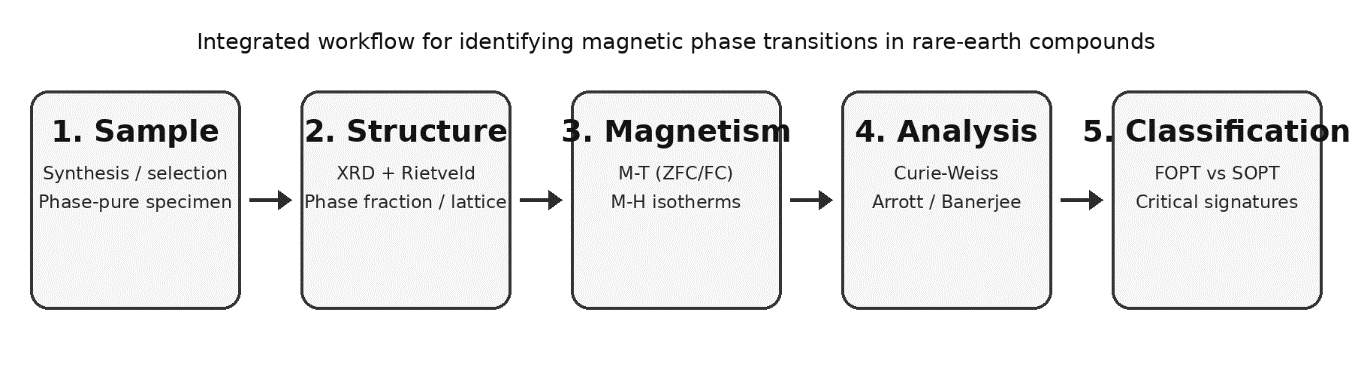
Rare-earth compounds exhibit a wide spectrum of magnetic phase transitions because localized 4f moments interact with crystal fields, conduction electrons, lattice strain, and, in many intermetallics, transition-metal 3d states. This methodology paper presents a reproducible framework for identifying the transition temperature and classifying a transition as first-order, second-order, antiferromagnetic, ferromagnetic, or metamagnetic. The workflow combines phase verification by X-ray diffraction, temperature-dependent magnetization, Curie-Weiss analysis, field-dependent magnetization, Arrott/Banerjee criteria, and magnetic-entropy scaling. Literature-reported rare-earth systems up to 2021 are used as benchmarks rather than as new experimental measurements. The benchmark comparison shows that Gd5Si2Ge2-based alloys can move between first- and second-order behavior through thermal processing or chemical substitution, while RAl3C3 compounds display rare-earth-dependent ferromagnetic and antiferromagnetic states. The proposed method therefore links structural state, magnetic response, and thermodynamic signatures in a single analysis sequence. It is suitable for rare-earth intermetallics and related compounds were coupled magnetic and lattice degrees of freedom control functional properties such as magnetocaloric response, magnetostriction, and reversible field-induced phase switching.