Study of Magnetic Properties of Transition Metal Oxide Nanoparticles
DOI:
https://doi.org/10.65521/apl.v5i1.4239Keywords:
Abstract
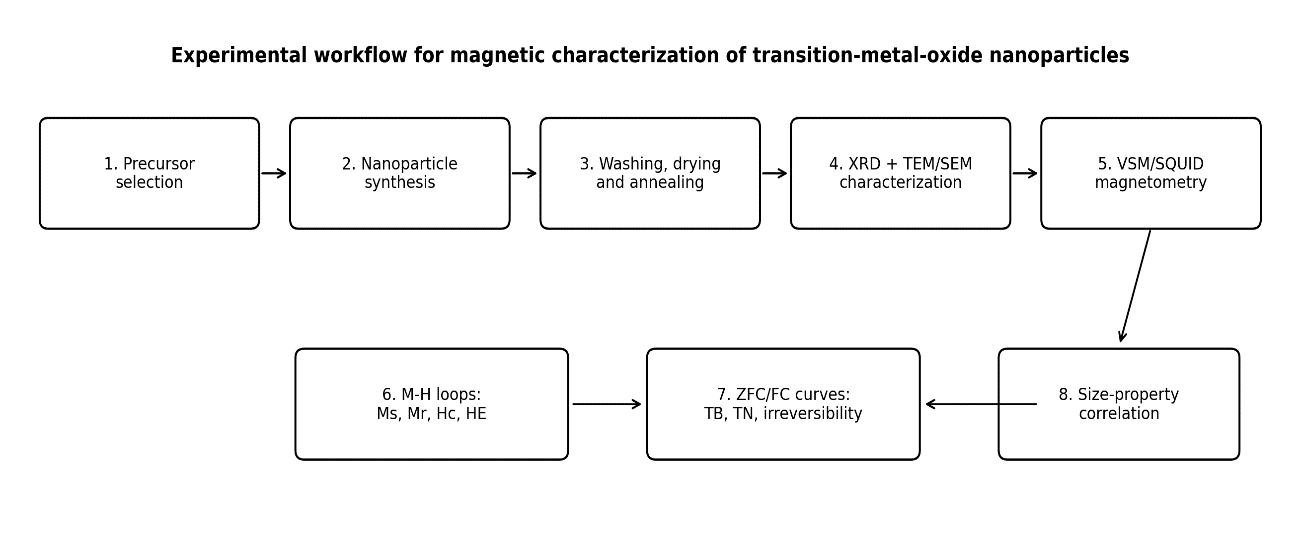
Transition metal oxide nanoparticles display magnetic responses that differ markedly from their bulk counterparts because particle size, surface-to-volume ratio, lattice defects, oxidation state, and interparticle interactions modify magnetic exchange and anisotropy. This methodology paper presents a reproducible experimental framework for studying the magnetic properties of representative oxide nanoparticles such as NiO, CoO/Co3O4, MnO, CuO, and Fe3O4. The approach combines controlled wet-chemical synthesis, thermal treatment, X-ray diffraction (XRD), electron microscopy, and vibrating-sample or SQUID magnetometry. Structural size is estimated from diffraction-line broadening and cross-checked with transmission electron microscopy. Magnetic characterization includes room- and low-temperature M-H hysteresis loops, zero-field-cooled/field-cooled (ZFC/FC) magnetization, and extraction of saturation magnetization, remanence, coercive field, exchange-bias field, blocking temperature, and magnetic transition temperature. Literature through 2016 consistently shows that nanoscaling can produce uncompensated surface spins, reduced antiferromagnetic ordering temperatures, enhanced coercivity, exchange bias, and superparamagnetic or weak-ferromagnetic-like behavior. The proposed protocol therefore emphasizes particle-size control and surface-state analysis as the central variables governing interpretation. Because no original raw dataset was supplied, the Results section reports benchmark trends and expected signatures derived from peer-reviewed studies rather than presenting fabricated experimental measurements.