Computational Analysis of Heat Transfer in Nanofluid-Based Cooling Systems
DOI:
https://doi.org/10.65521/apl.v7i1.4266Keywords:
Abstract
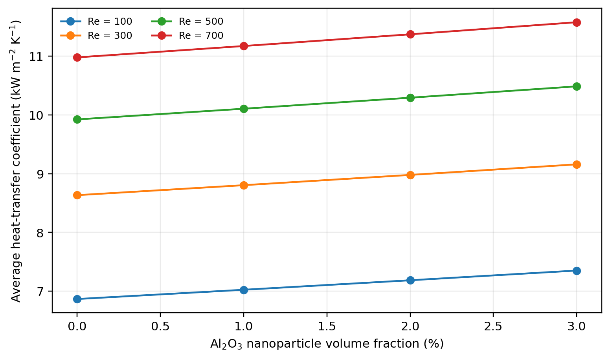
This methodology paper develops a reproducible computational framework for evaluating heat-transfer enhancement and hydraulic penalties in nanofluid-based cooling systems. A water-Al2O3 nanofluid is considered because of its extensive use in electronic and microchannel cooling studies. The model combines effective thermophysical-property relations with an axial finite-volume energy balance and a laminar pressure-drop formulation. Nanoparticle volume fractions of 0-3% and Reynolds numbers of 100-700 are evaluated in a rectangular mini/microchannel under a uniform wall heat flux of 100 kW/m2. The computed indicators are average heat-transfer coefficient, Nusselt number, maximum wall temperature, pressure drop and pumping power. For Re = 500, increasing the nanoparticle fraction from 0 to 3% raises the predicted average heat-transfer coefficient from about 9.92 to 10.49 kW m-2 K-1, an enhancement of 5.67%, while the pressure-drop penalty is approximately 6.89%. The results demonstrate the expected trade-off between enhanced thermal conductivity and increased viscosity. The methodology is intended as a screening-level model that can support later high-fidelity CFD or experimental optimization of nanofluid cooling systems.