Quantum Entanglement and Information Transfer in Multi-Qubit Computing Systems
DOI:
https://doi.org/10.65521/apl.v9i1.4285Keywords:
Abstract
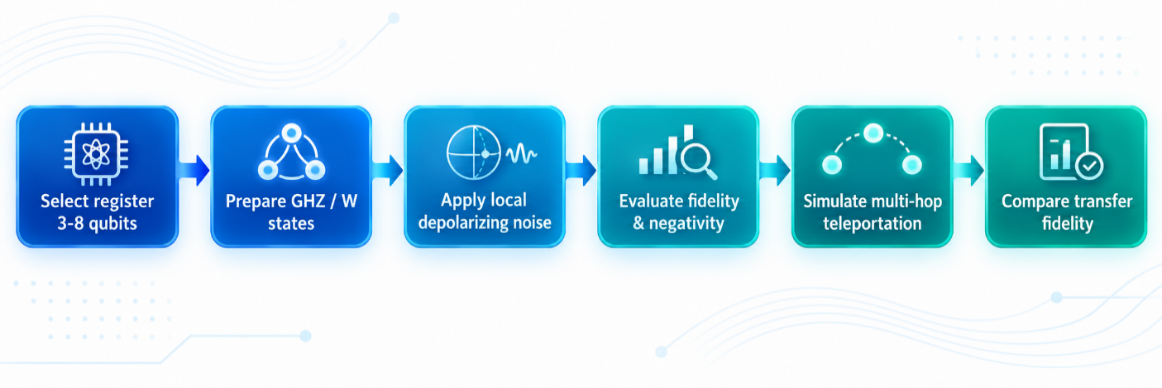
Quantum entanglement is a central resource for quantum computation and state transfer, yet the usefulness of multipartite entanglement depends on how rapidly coherence and nonclassical correlations degrade as the register size and communication depth increase. This methodology paper develops a reproducible density-matrix simulation for studying entanglement and information transfer in multi-qubit systems. GHZ and W states containing 3, 4, 5, 6 and 8 qubits are generated and exposed to independent local depolarizing noise. State fidelity and bipartite negativity are used to quantify preservation of the prepared resource, while an entanglement-assisted multi-hop teleportation model measures the fidelity of transferred single-qubit information. The simulation shows a systematic decrease in state fidelity and negativity with increasing register size at a fixed local error probability. At a local depolarizing probability of 0.02, GHZ fidelity decreases from 0.941 for three qubits to 0.852 for eight qubits, whereas W-state fidelity decreases from 0.943 to 0.877. In a separate transfer experiment with an effective error probability of 0.10 per teleportation hop, average transfer fidelity decreases from 0.933 after one hop to 0.745 after five hops, while remaining above the classical benchmark of 2/3. These results illustrate how multipartite entanglement quality; noise accumulation and path depth jointly determine the reliability of information transfer in multi-qubit computing architectures.