Modelling and Simulation of Photonic Crystal Structures for Enhanced Light Transmission
DOI:
https://doi.org/10.65521/apl.v8i1.4272Keywords:
Abstract
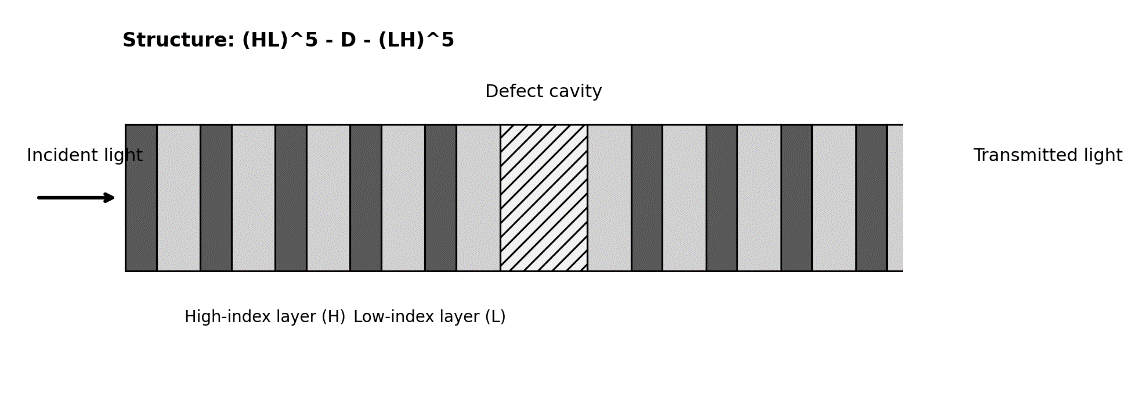
Photonic crystals provide a structured route for controlling the propagation, reflection, confinement, and extraction of light through periodic modulation of refractive index. This methodology paper develops a compact numerical framework for enhancing optical transmission by introducing a resonant defect into a one-dimensional dielectric photonic crystal. A high-index/low-index quarter-wave multilayer is modeled at a design wavelength of 1550 nm, and its spectral response is calculated with the transfer-matrix method (TMM). The regular periodic stack is first used to identify the photonic stop band. A half-wave defect cavity is then inserted between two Bragg mirrors, producing a narrow transmission state inside the forbidden band. The method includes geometry definition, material assignment, matrix formulation, wavelength sweep, defect-thickness optimization, and an FDTD-based validation protocol. Simulated results show that the regular stack strongly suppresses transmission near the design wavelength, whereas the symmetric defect configuration supports a resonant transmission peak approaching unity under lossless normal-incidence assumptions. The proposed workflow is suitable for methodological studies of optical filters, resonant sensors, integrated photonic structures, and light-management layers, while remaining simple enough for reproducible parametric optimization.