Application of Finite Element Methods in Electromagnetic Field Simulations
DOI:
https://doi.org/10.65521/apl.v4i1.4192Keywords:
Abstract
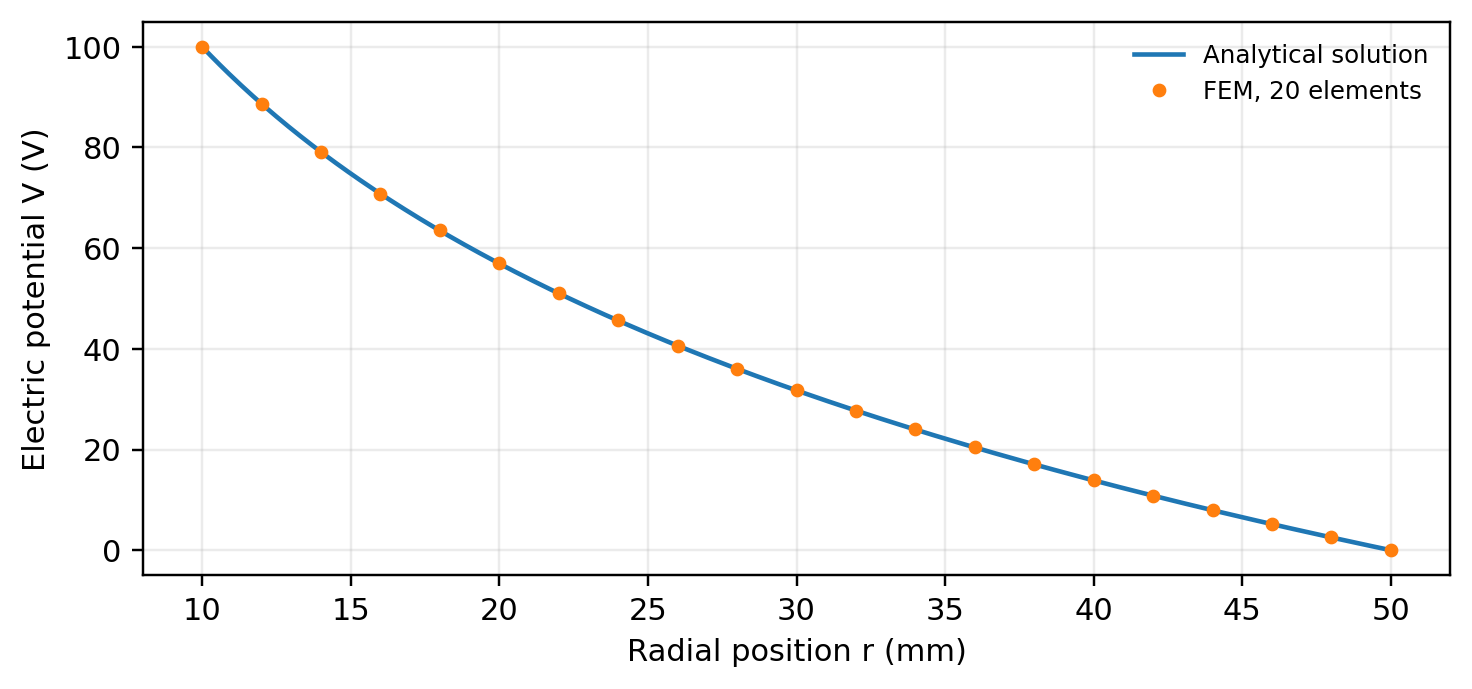
Finite element methods (FEM) provide a flexible numerical framework for electromagnetic field simulation when geometry, material interfaces, and boundary conditions make analytical solutions impractical. This methodology paper presents a compact workflow for electrostatic and time-harmonic electromagnetic analysis based on Maxwell’s equations, weak formulations, mesh discretization, and appropriate finite-element spaces. Particular emphasis is placed on curl-conforming edge elements, which preserve tangential field continuity and reduce nonphysical spurious modes in vector wave problems. A reproducible axisymmetric coaxial electrostatic benchmark is used to demonstrate the validation stage of the workflow. Linear FEM solutions are compared with the closed-form logarithmic potential distribution while the radial mesh is refined from 10 to 80 elements. The relative electric-field error decreases from 0.388% to 0.0062%, with an observed convergence rate close to second order for the selected error measure. The study shows that reliable electromagnetic FEM depends not only on solving a matrix system but also on choosing a physically compatible formulation, controlling mesh quality, applying correct boundary conditions, and verifying the numerical solution against analytical or reference data. The proposed procedure can be extended to waveguides, eddy-current devices, antennas, scattering problems, and heterogeneous electromagnetic media.