Effect of Annealing Temperature on the Luminescence Characteristics of LED Phosphors
DOI:
https://doi.org/10.65521/apl.v6i1.4250Keywords:
Abstract
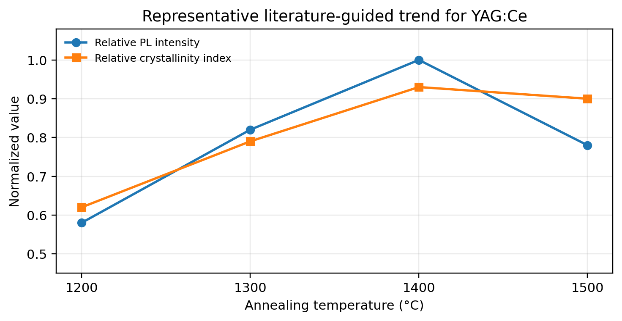
Annealing is a decisive processing step in inorganic light-emitting-diode (LED) phosphors because it controls phase formation, crystallinity, defect density, activator incorporation, particle growth, and ultimately radiative efficiency. This methodology paper develops a controlled experimental framework for evaluating the effect of annealing temperature on the luminescence of cerium-activated yttrium aluminum garnet (YAG:Ce), a benchmark yellow phosphor for phosphor-converted white LEDs. Four annealing temperatures (1200, 1300, 1400, and 1500 °C) are proposed while composition, dwell time, atmosphere, heating rate, and sample mass are held constant. Structural evolution is assessed by X-ray diffraction and scanning electron microscopy, whereas photoluminescence spectra, decay lifetime, quantum yield, and CIE chromaticity are used to quantify optical performance. Literature published up to 2017 indicates that increasing annealing temperature generally improves crystal quality and luminescence until an optimum is reached, after which excessive grain growth, agglomeration, or defect/valence changes may reduce useful emission. A literature-guided representative dataset illustrates a maximum relative emission near 1400 °C, consistent with direct YAG:Ce annealing studies. The proposed method provides a reproducible basis for identifying a processing window that balances high crystallinity with favorable morphology and optical conversion efficiency.