
Energy-Efficient Routing Protocols for Wireless Sensor Networks: A Performance Evaluation
Keywords:
Abstract
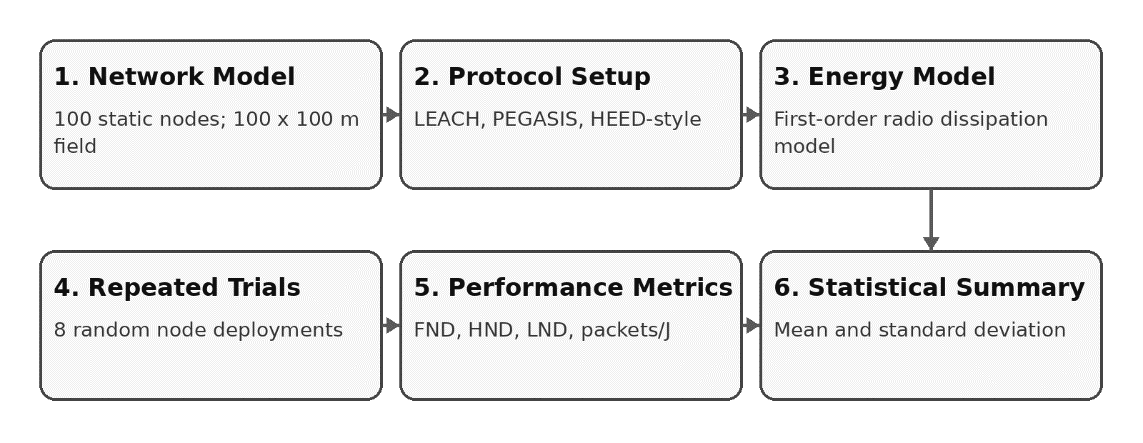
Wireless sensor networks (WSNs) are typically formed by battery-powered nodes whose operational lifetime is strongly influenced by radio communication and routing decisions. This methodology paper evaluates three representative energy-efficient routing approaches—Low-Energy Adaptive Clustering Hierarchy (LEACH), Power-Efficient GAthering in Sensor Information Systems (PEGASIS), and Hybrid Energy-Efficient Distributed clustering (HEED)—under a common first-order radio-energy model. The study uses a controlled simulation design with 100 static sensor nodes randomly deployed in a 100 m × 100 m field and a fixed base station outside the sensing region. Eight independent network deployments are executed for each protocol abstraction. Performance is assessed using first-node-death (FND), half-node-death (HND), last-node-death (LND), total successfully represented source packets, and packet-per-joule efficiency. The evaluation shows that PEGASIS provides the highest mean HND and LND and the greatest packet-per-joule efficiency, while HEED provides the longest stable period before FND because residual energy is explicitly considered during cluster-head selection. LEACH remains simple and scalable but shows earlier first-node failure due to probabilistic cluster-head rotation. The results demonstrate that no single protocol dominates all criteria; protocol selection should consider lifetime, delay, topology-control overhead, and deployment requirements. The study is reproducible and deliberately separates protocol-level routing effects from lower-layer channel losses
Downloads
Downloads
Published
How to Cite
Issue
Section
License

This work is licensed under a Creative Commons Attribution-NoDerivatives 4.0 International License.
