
Energy-Efficient Routing Protocol for Wireless Sensor Networks in Industrial Monitoring Applications
Keywords:
Abstract
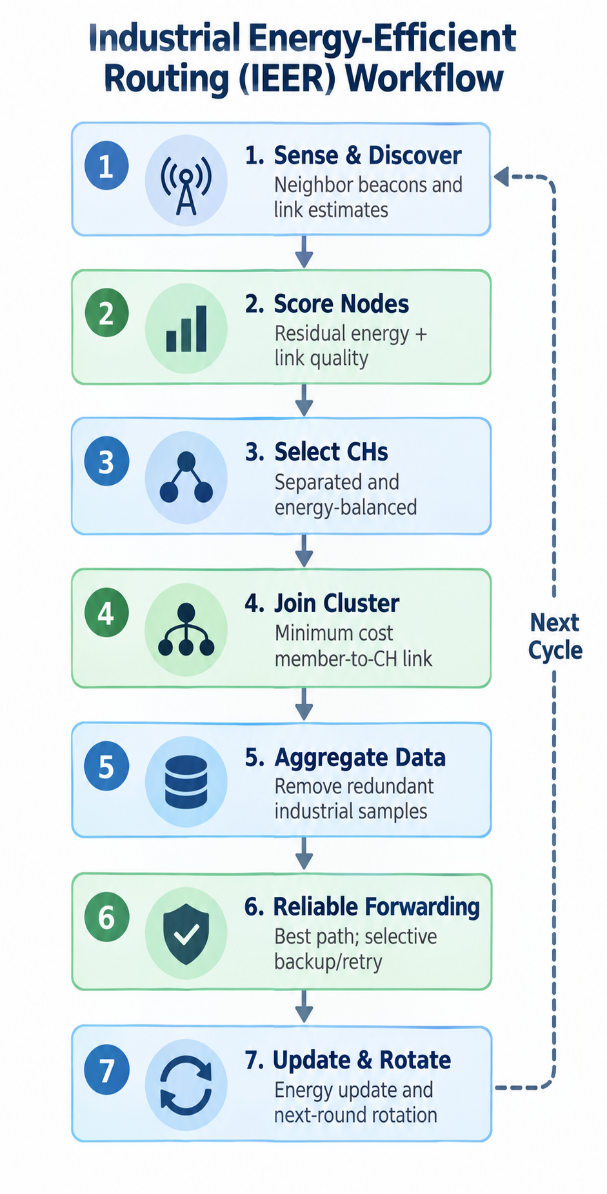
Industrial wireless sensor networks (IWSNs) are increasingly used for condition monitoring, process observation, predictive maintenance, and asset surveillance, but the limited battery capacity of sensor nodes and the harsh radio environment make routing efficiency a central design concern. This methodology paper proposes an Industrial Energy-Efficient Routing (IEER) protocol that combines residual-energy awareness, link-quality estimation, cluster-head separation, data aggregation, and selective reliability support. The protocol is designed for non-safety-critical industrial monitoring in which data delivery must remain reliable while network maintenance overhead and energy expenditure are minimized. A simulation-oriented methodology is defined using a first-order radio-energy model, 100 stationary sensor nodes, a 100 m x 100 m industrial area, and comparisons with LEACH, HEED, and PEGASIS. Performance is evaluated using first-node-death, half-node-death, last-node-death, packet-delivery ratio, and end-to-end delay. Representative model results show that IEER extends the stable operating period relative to LEACH and HEED and achieves high delivery reliability with substantially lower delay than chain-based PEGASIS. The findings indicate that combining energy balance with link quality is more suitable for industrial monitoring than using energy or hop count alone.
Downloads
Downloads
Published
How to Cite
Issue
Section
License

This work is licensed under a Creative Commons Attribution-NoDerivatives 4.0 International License.
