
Design and Performance Analysis of Energy-Efficient Wireless Sensor Networks for Environmental Monitoring
Keywords:
Abstract
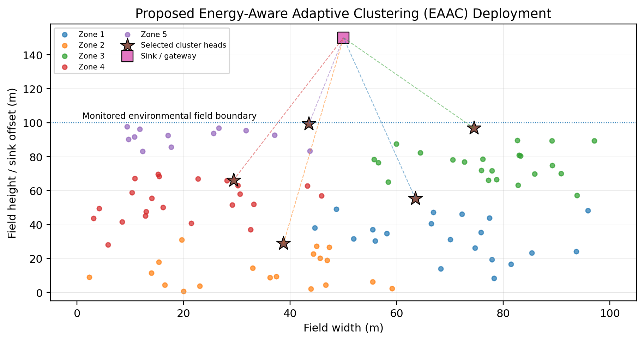
Wireless sensor networks (WSNs) enable continuous observation of temperature, humidity, air quality, soil, water, and other environmental variables in locations where wired infrastructure is impractical. Their principal operational limitation is the finite energy stored in distributed sensor nodes, because radio transmission, reception, idle listening, and repeated forwarding progressively shorten network lifetime. This methodology paper presents a reproducible design and performance-analysis framework for an energy-efficient WSN intended for environmental monitoring. The proposed architecture uses spatial clustering, periodic sensing, in-network aggregation, and residual-energy-aware cluster-head selection. A first-order radio energy model is used to compare direct transmission, conventional low-energy adaptive clustering hierarchy (LEACH), and a proposed Energy-Aware Adaptive Clustering (EAAC) approach under a common 100-node deployment. The evaluation considers first-node death, half-node death, and node-survival behavior over 5,000 communication rounds. Modeled results indicate that EAAC delays first-node death from 2,569 rounds under LEACH to 3,713 rounds and extends the half-node lifetime from 4,135 to 4,430 rounds. The findings support the methodological value of balancing residual energy, spatial distribution, and sink-transmission cost when designing long-lived environmental monitoring networks. The numerical results are simulation-based and should be validated with hardware-specific current measurements before field deployment.
Downloads
Downloads
Published
How to Cite
Issue
Section
License

This work is licensed under a Creative Commons Attribution-NoDerivatives 4.0 International License.
