
Design and Performance Analysis of Energy-Efficient Wireless Sensor Networks for Industrial Monitoring
Keywords:
Abstract
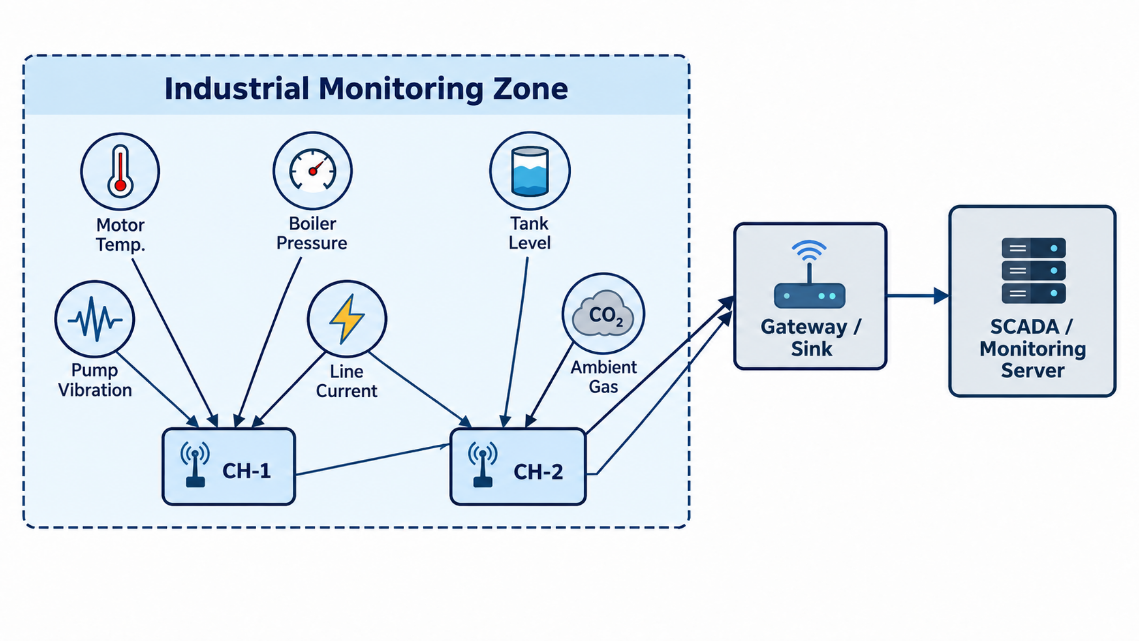
Industrial monitoring increasingly relies on distributed sensing of temperature, vibration, pressure, current, gas concentration, and equipment condition. Wireless sensor networks (WSNs) reduce cabling effort and permit flexible deployment, but battery-powered sensor nodes must operate for long periods in environments affected by interference, obstacles, multipath propagation, and maintenance constraints. This methodology paper develops and evaluates an energy-efficient industrial WSN architecture based on residual-energy-aware cluster-head selection, short-range member-to-cluster-head communication, time-division multiple access (TDMA) duty cycling, and in-network data aggregation. The study uses a first-order radio-energy model and a numerical simulation of 100 sensor nodes distributed over a 100 m × 100 m industrial area, with a gateway located outside the sensing field. Direct transmission and conventional LEACH are used as baselines. Across 20 random deployments, the proposed design increased the mean first-node-death point from 165 rounds for direct transmission and 761 rounds for LEACH to approximately 929 rounds. At round 1000, the proposed design retained an average of 71 active nodes, compared with 56 for LEACH and 32 for direct transmission. These results indicate that combining spatial clustering with residual-energy-aware role rotation can improve the stability period of industrial monitoring networks while preserving a simple distributed architecture. The paper provides a reproducible step-by-step methodology, simulation parameters, evaluation metrics, and limitations suitable for subsequent implementation in NS-2/NS-3, MATLAB, OMNeT++, or a physical IEEE 802.15.4/WirelessHART testbed.
Downloads
Downloads
Published
How to Cite
Issue
Section
License

This work is licensed under a Creative Commons Attribution-NoDerivatives 4.0 International License.
