
Design and Performance Evaluation of Energy-Efficient Wireless Sensor Networks for Smart Monitoring Applications
Keywords:
Abstract
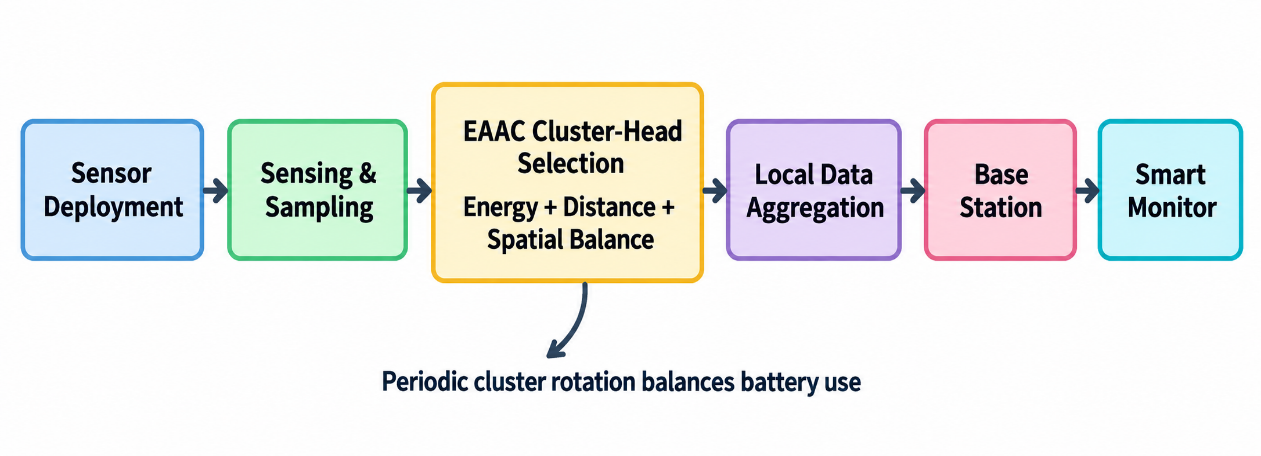
Wireless sensor networks (WSNs) enable distributed sensing for environmental, industrial, agricultural, structural, and building-monitoring applications, but their practical lifetime is constrained by the limited battery capacity of sensor nodes. This methodology paper develops and evaluates an energy-efficient WSN design for smart monitoring applications using adaptive clustering, residual-energy-aware cluster-head selection, distance-aware communication, and local data aggregation. The proposed Energy-Aware Adaptive Clustering (EAAC) method selects cluster heads using a composite score that considers residual battery energy, distance to the base station, spatial separation among cluster heads, and a rotation factor that discourages repeated selection of the same node. Performance is assessed using a first-order radio-energy model and repeated random network deployments containing 100 nodes in a 100 m x 100 m sensing field. The evaluation uses first-node death, half-node death, residual network energy, and number of alive nodes as the principal metrics, with a LEACH-like randomized clustering scheme used as the baseline. In the methodological simulation, EAAC increased the mean first-node-death round from approximately 819 to 1,125 rounds, retained all nodes alive at round 1,000 across the evaluated deployments, and preserved about 6.8% more residual energy at round 800 than the baseline. These results indicate that combining energy awareness with communication distance and cluster distribution can improve the stable operating period of WSNs used for smart monitoring. The study is designed as a reproducible simulation methodology rather than a substitute for hardware validation, and it identifies field testing, link-quality modeling, and duty-cycling integration as important extensions.
Downloads
Downloads
Published
How to Cite
Issue
Section
License

This work is licensed under a Creative Commons Attribution-NoDerivatives 4.0 International License.
