
Performance Analysis of Grid-Connected Solar Photovoltaic Systems under Variable Environmental Conditions
Keywords:
Abstract
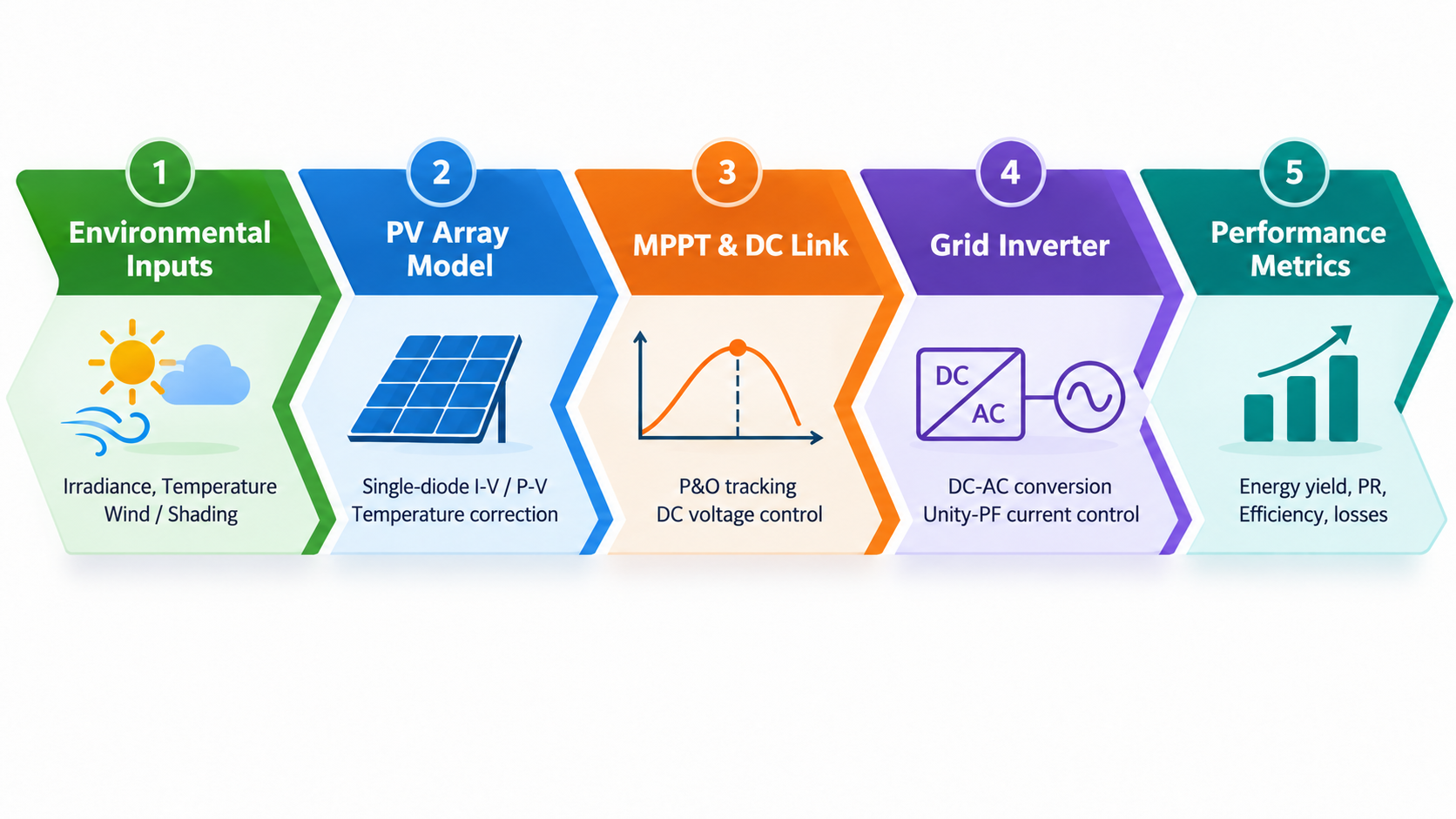
Grid-connected photovoltaic (PV) generation is strongly affected by short-term and seasonal changes in solar irradiance, module temperature, wind, cloud cover, and partial shading. This methodology paper develops a reproducible framework for evaluating a grid-connected PV system under variable environmental conditions using a physics-based PV model, maximum power point tracking (MPPT), inverter conversion, and standardized performance indicators. The proposed study combines a single-diode PV representation with measured or synthetically imposed irradiance and temperature profiles. A 5 kWp reference array is evaluated across irradiance levels of 200–1000 W/m² and cell temperatures of 25–55°C. The analysis focuses on DC power, AC energy delivered to the grid, conversion efficiency, specific yield, and performance ratio. Scenario results show that irradiance controls the dominant variation in instantaneous output, while elevated cell temperature causes a systematic reduction in voltage and maximum power. For the modeled system, increasing cell temperature from 25°C to 55°C at 1000 W/m² reduces grid-side power by approximately 12.3%, consistent with established temperature-coefficient behavior. The method also incorporates MPPT and inverter losses so that environmental effects are not evaluated independently of balance-of-system performance. The framework is intended for simulation studies, field-data validation, and comparative assessment of PV installations in different climates
Downloads
Downloads
Published
How to Cite
Issue
Section
License

This work is licensed under a Creative Commons Attribution-NoDerivatives 4.0 International License.
