
Optimization of Solar Photovoltaic Power Generation Using Maximum Power Point Tracking Techniques
Keywords:
Abstract
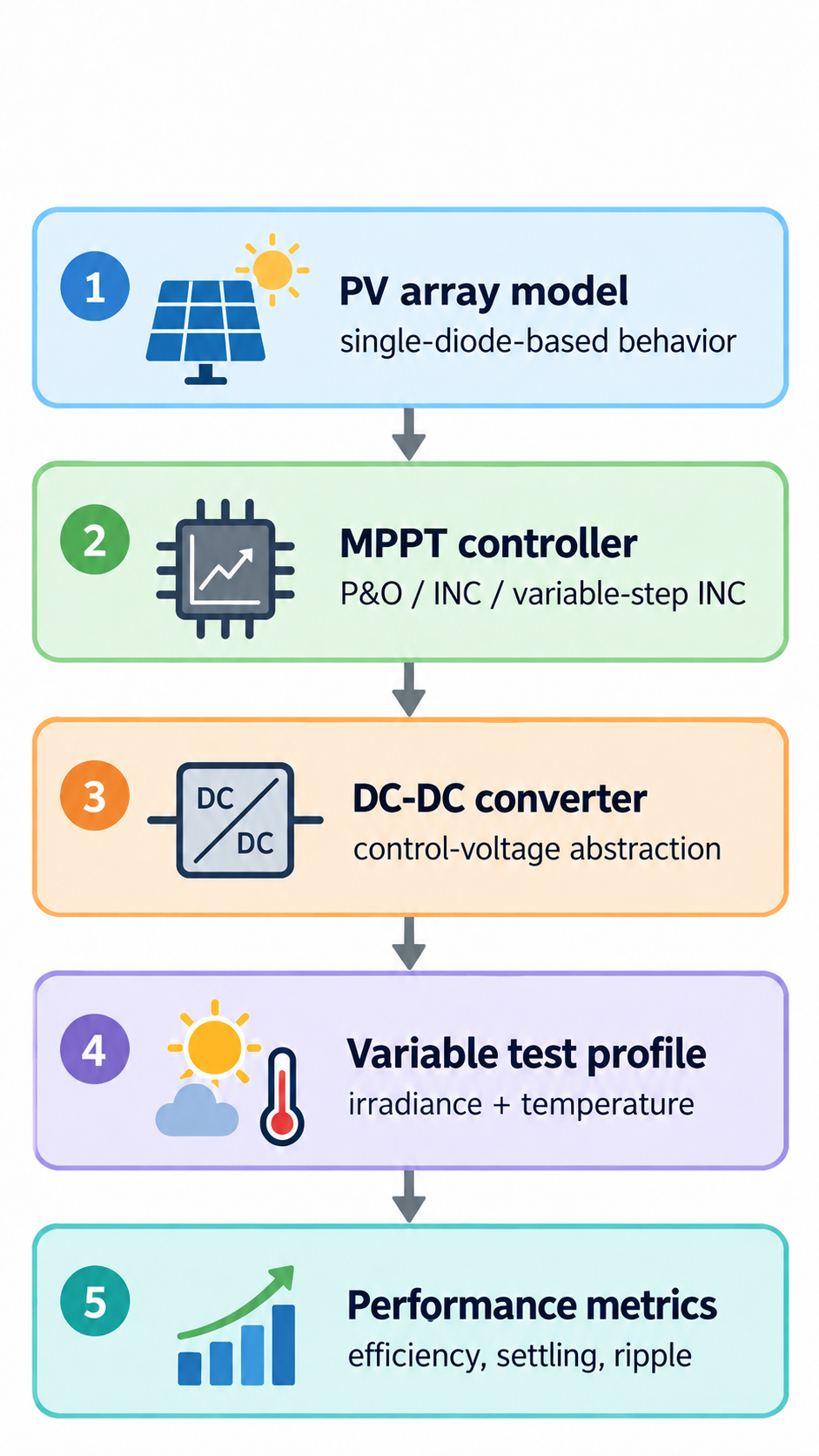
Maximum power point tracking (MPPT) is a central control function in photovoltaic (PV) energy-conversion systems because the operating point that yields maximum electrical power shifts continuously with solar irradiance, cell temperature, and load conditions. This methodology paper develops a reproducible framework for optimizing solar PV power generation through comparative implementation of three widely used MPPT strategies: perturb and observe (P&O), incremental conductance (INC), and a variable-step incremental conductance method. A nonlinear PV source model is coupled to a controlled DC-DC conversion stage, and the algorithms are evaluated under step changes in irradiance and temperature. The study uses tracking efficiency, initial settling time, steady-state ripple, algorithmic complexity, and sensor requirements as the principal evaluation criteria. The simulation-based comparison shows that all three methods can operate close to the theoretical maximum power point, while variable-step INC provides the best combined dynamic and energy-capture performance in the selected test profile. The paper also identifies why fixed-step P&O remains attractive for low-cost applications despite oscillation and drift limitations, and why adaptive methods are better suited to rapidly changing solar conditions. The proposed workflow can be reproduced in MATLAB/Simulink or an equivalent numerical environment and can be extended to partial-shading and hardware-in-the-loop experiments.
Downloads
Downloads
Published
How to Cite
Issue
Section
License

This work is licensed under a Creative Commons Attribution-NoDerivatives 4.0 International License.
