
Development of Solar-Powered Electric Vehicle Charging Stations for Sustainable Transportation
Keywords:
Abstract
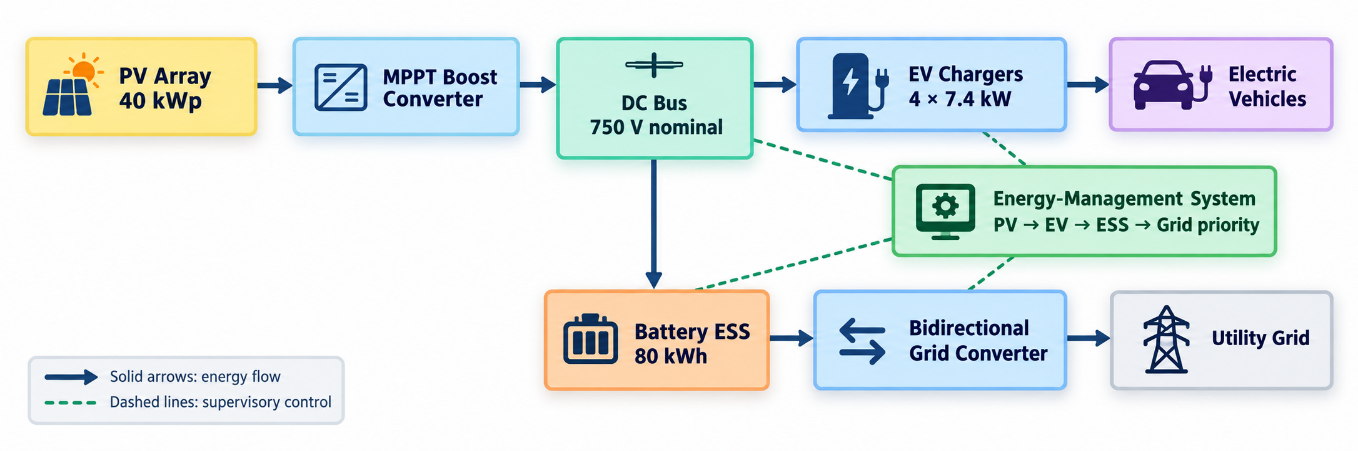
The transition to electric mobility can reduce urban tailpipe emissions, but its sustainability depends strongly on the electricity used for charging. This methodology paper develops a technically practical framework for a solar-powered electric vehicle charging station (EVCS) that combines a photovoltaic (PV) array, battery energy storage system (BESS), bidirectional power-electronic converters, grid support, and an energy management system (EMS). The proposed design is intended for an urban or institutional parking facility and prioritizes direct PV-to-vehicle charging, uses the BESS to shift excess daytime solar energy, and relies on the grid only when renewable energy and stored energy are insufficient. The methodology includes load estimation, PV sizing, BESS sizing, converter selection, state-of-charge constraints, supervisory control logic, and evaluation through clear-sky, typical-solar, and cloudy-solar scenarios. A representative design with a 40 kWp PV plant, 80 kWh BESS, and four 7.4 kW charging points is examined. Under the stated assumptions, illustrative simulation calculations indicate that the renewable fraction can range from about 56% on a cloudy day to more than 95% on a clear day, while grid peak demand is substantially reduced compared with uncontrolled grid-only charging. The framework is consistent with pre-2021 research demonstrating the value of PV-assisted charging, storage, smart scheduling, and vehicle-to-grid capable power management [1]-[10]. The paper therefore offers a replicable step-by-step methodology for designing and evaluating sustainable solar EV charging infrastructure without claiming unperformed field experiments.
Downloads
Downloads
Published
How to Cite
Issue
Section
License

This work is licensed under a Creative Commons Attribution-NoDerivatives 4.0 International License.
