
Design and Performance Analysis of a Solar-Powered Smart Irrigation System for Sustainable Agriculture
Keywords:
Abstract
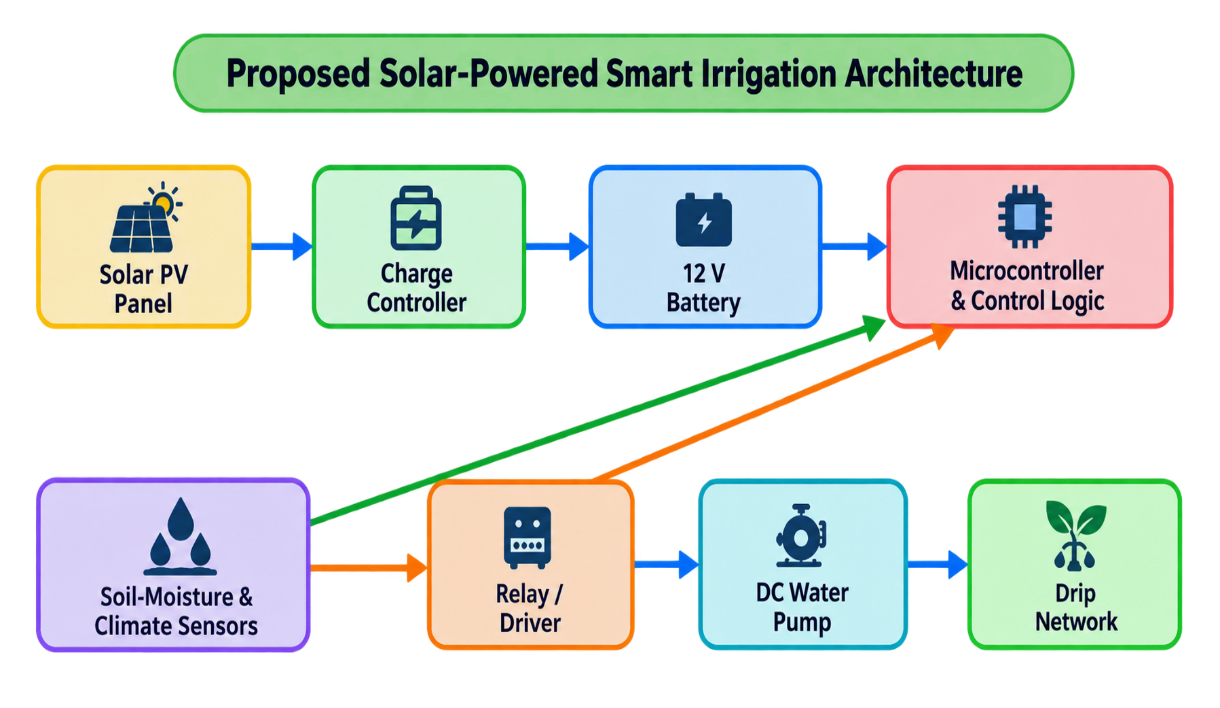
Efficient irrigation and clean energy are complementary requirements for sustainable agriculture, particularly in regions where grid electricity is unreliable and freshwater resources are constrained. This methodology paper presents the design and performance-analysis framework for a solar-powered smart irrigation system that combines photovoltaic energy, soil-moisture sensing, microcontroller-based decision logic, a direct-current pump, and drip irrigation. The proposed approach uses threshold-based feedback control to irrigate only when root-zone moisture falls below a lower limit and to terminate pumping after a target moisture level is restored. The methodology includes component sizing, sensor calibration, control-algorithm design, energy–water balance calculations, and a comparative simulation against fixed-time irrigation. A seven-day representative evaluation scenario indicates that the proposed control strategy can reduce irrigation water and pump energy use by approximately 36% while maintaining root-zone moisture within the desired band for a larger proportion of time. The photovoltaic subsystem provides a daily energy margin sufficient for sensing, control, communication, and pumping under the assumed solar resource. The study demonstrates a reproducible framework for integrating renewable power and sensor-based irrigation while clearly separating model-based performance results from field-validated claims. The design is intended for small and medium agricultural plots where low operating cost, water conservation, and energy autonomy are priorities.
Downloads
Downloads
Published
How to Cite
Issue
Section
License

This work is licensed under a Creative Commons Attribution-NoDerivatives 4.0 International License.
