
Performance Analysis of Solar Photovoltaic Systems under Variable Environmental Conditions
Keywords:
Abstract
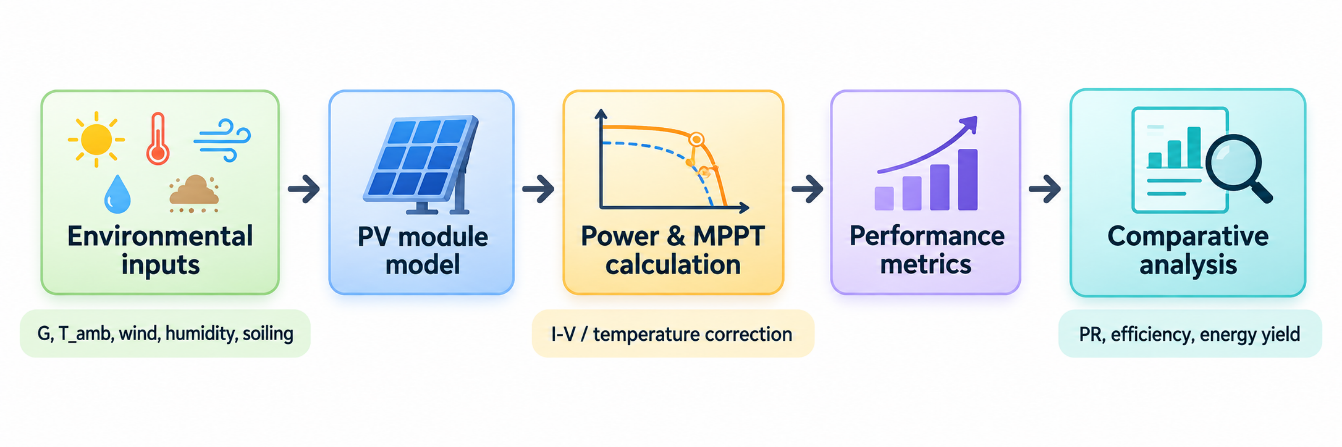
The electrical output of a solar photovoltaic (PV) system is strongly governed by environmental conditions that differ from the standard test conditions used for module ratings. This methodology paper develops a structured procedure for evaluating PV performance under variable solar irradiance, ambient and module temperature, wind speed, humidity, and surface soiling. The approach combines field-oriented data acquisition with a validated PV performance model, temperature correction, maximum-power-point estimation, and normalized indicators including conversion efficiency, performance ratio, and energy yield. A representative 250 W crystalline-silicon module is used to demonstrate the analysis without claiming unreported experimental measurements. The modeled results show that irradiance is the dominant driver of instantaneous power, while increased operating temperature reduces the fraction of rated power obtainable at a given irradiance. Under the adopted nominal operating cell temperature relationship, an increase in ambient temperature from 15 C to 45 C at 1000 W/m2 lowers predicted maximum power from about 226 W to 192 W. The methodology therefore emphasizes simultaneous measurement of irradiance and module temperature and recommends secondary monitoring of wind, humidity, and soiling to interpret field deviations. The proposed framework is suitable for laboratory validation, rooftop systems, and comparative outdoor PV studies.
Downloads
Downloads
Published
How to Cite
Issue
Section
License

This work is licensed under a Creative Commons Attribution-NoDerivatives 4.0 International License.
