Preparation and Evaluation of Modified Rice-Husk Biochar for Heavy Metal Removal from Wastewater
DOI:
https://doi.org/10.65521/ijaeee.v11i1.4613Keywords:
Abstract
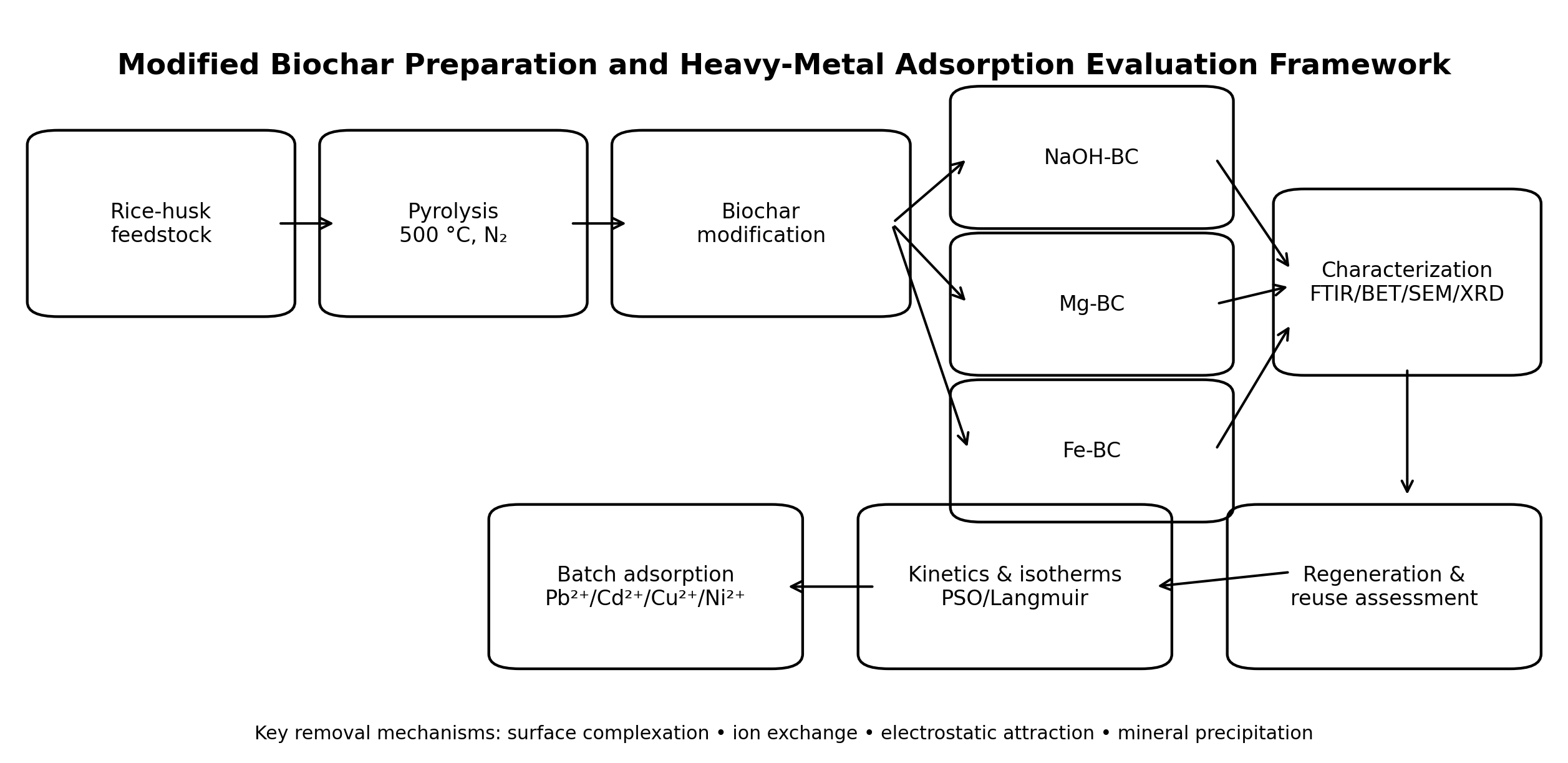
Heavy-metal contamination of industrial wastewater remains difficult to manage because Pb(II), Cd(II), Cu(II), Ni(II), and related ions are persistent, non-biodegradable, and can accumulate in ecological and human systems. Biochar produced from agricultural residues is a promising adsorbent, but pristine biochar often has limited accessible surface functionality and inconsistent affinity for dissolved metal ions. This methodology paper develops a comparative framework for preparing and evaluating modified biochar materials for wastewater polishing. Rice-husk-derived biochar is proposed as the base material and three modification strategies are investigated: alkaline activation (NaOH-BC), magnesium loading (Mg-BC), and iron-based magnetic modification (Fe-BC). The protocol integrates material preparation, physicochemical characterization, batch adsorption, kinetic and equilibrium modelling, competitive multi-metal testing, and regeneration/reuse. Removal percentage and equilibrium capacity are measured using residual metal concentrations determined by atomic absorption spectroscopy or ICP-OES. Pseudo-first-order and pseudo-second-order kinetics and Langmuir/Freundlich isotherms are fitted to identify rate and equilibrium behavior. Representative methodology-validation data indicate that modification can substantially raise metal uptake relative to raw biochar, with Mg-BC expected to be particularly effective for divalent cations because of ion exchange, complexation, and mineral precipitation. The framework is intended to support reproducible comparison of modified biochars while emphasizing regeneration, secondary-waste control, and realistic mixed-ion conditions for sustainable wastewater treatment.