Development of Multifunctional PVA–GO–TiO₂ Polymer Nanocomposites for Industrial Durability and Environmental Remediation
DOI:
https://doi.org/10.65521/ijaeee.v8i1.4593Keywords:
Abstract
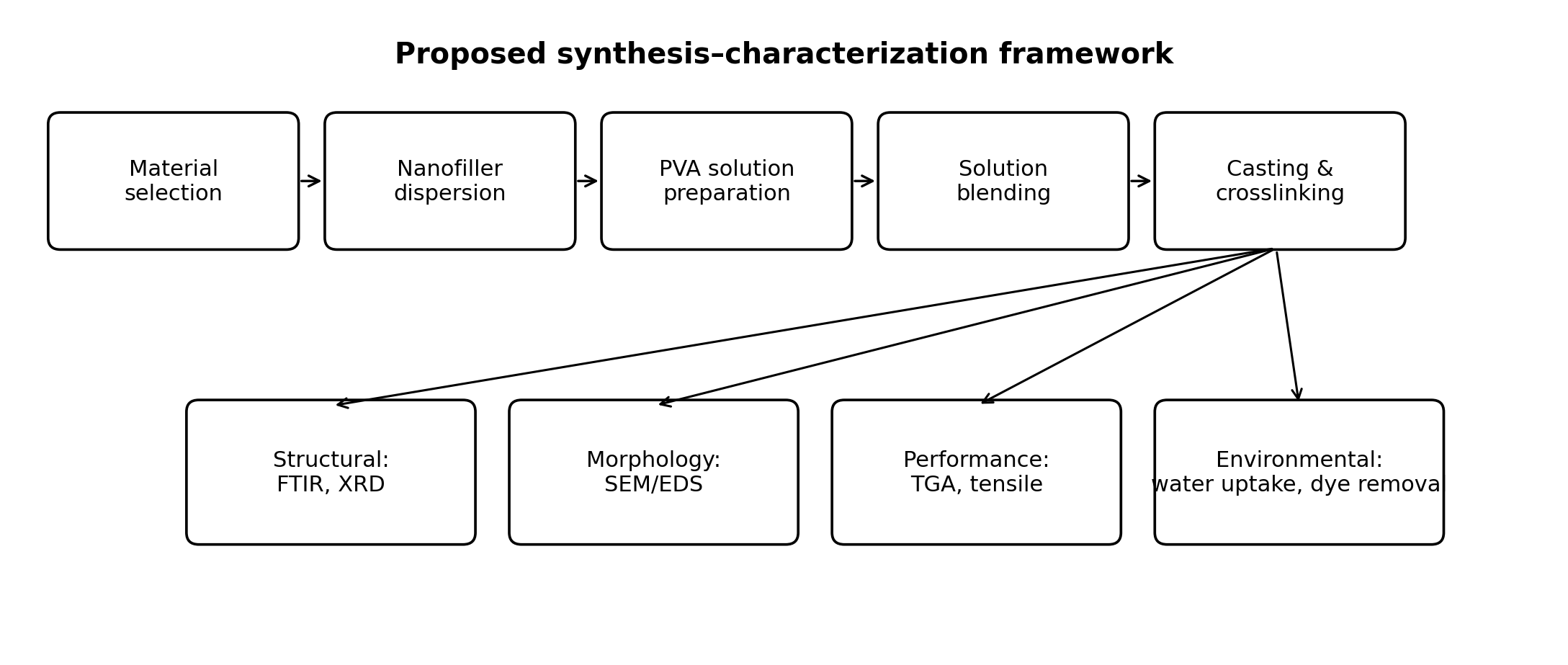
Polymer nanocomposites combine a continuous polymer phase with nanoscale fillers to create materials whose mechanical, thermal, barrier, electrical, and surface properties can be tailored at low filler loading. This methodology paper proposes a reproducible route for synthesizing and characterizing multifunctional polymer nanocomposites intended for both industrial and environmental applications. A crosslinked poly(vinyl alcohol) (PVA) matrix is selected as a model polymer because it can be processed from water and readily interacts with oxygen-containing nanofillers. Graphene oxide (GO), titanium dioxide (TiO₂), and a GO–TiO₂ hybrid are used as representative carbonaceous, metal-oxide, and hybrid nanofillers. The experimental design compares neat PVA with three nanocomposite formulations prepared by controlled dispersion, solution blending, casting, drying, and thermal crosslinking. Structure and dispersion are evaluated by Fourier-transform infrared spectroscopy (FTIR), X-ray diffraction (XRD), and scanning electron microscopy with energy-dispersive spectroscopy (SEM/EDS). Thermal stability, tensile properties, water uptake, and methylene-blue removal are measured to link morphology with industrial durability and environmental remediation performance. Literature-calibrated illustrative results predict that the hybrid nanocomposite can provide the best balance of tensile strength, thermal stability, dimensional integrity, and dye-removal efficiency when agglomeration is controlled. The framework is designed to support future laboratory validation and can be adapted to other polymer matrices, nanoclays, carbon nanomaterials, and metal-oxide fillers.