Investigation of Carbon Quantum Dots for Fluorescent Sensing of Environmental Pollutants
DOI:
https://doi.org/10.65521/ijaeee.v8i1.4578Keywords:
Abstract
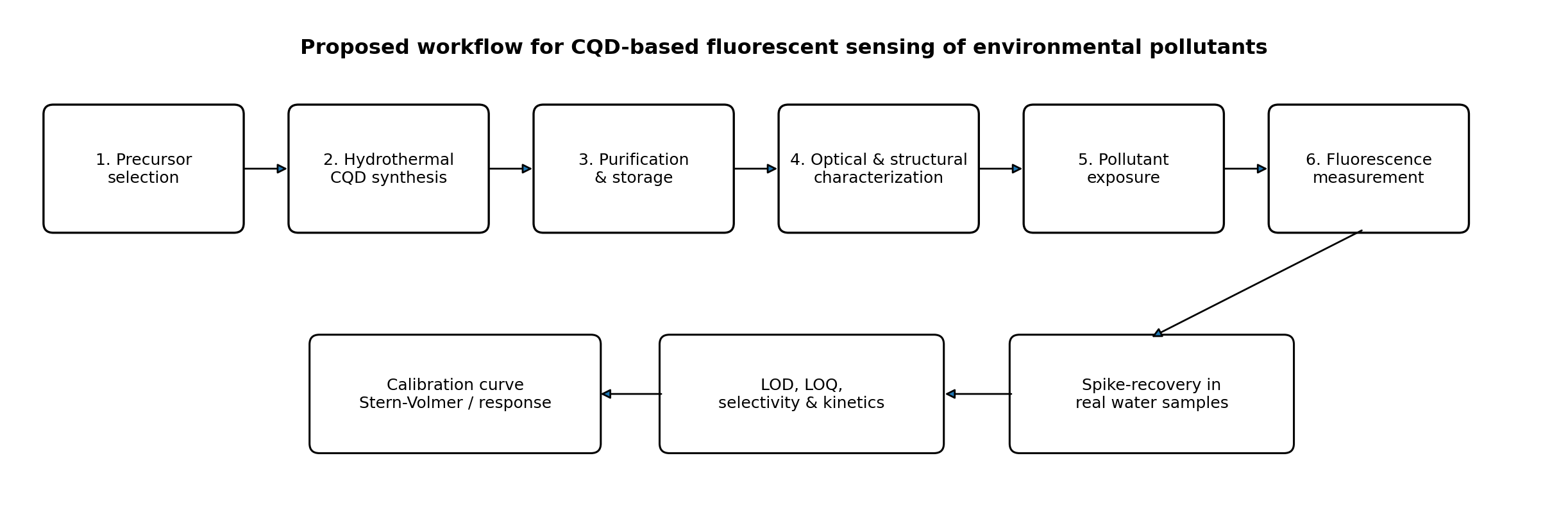
Carbon quantum dots (CQDs) are nanoscale, carbon-rich fluorophores that combine strong and tunable photoluminescence, water dispersibility, surface functionalization, comparatively low toxicity, and compatibility with inexpensive optical instrumentation. These characteristics make CQDs attractive for rapid screening of environmental pollutants that are otherwise quantified by laboratory-intensive chromatographic or spectrometric methods. This methodology paper develops a systematic experimental framework for investigating CQDs as fluorescent sensors for representative inorganic and organic pollutants, with emphasis on Hg2+ and Fe3+ ions, organophosphate pesticides, 4-nitrophenol, tetracycline-class antibiotics, picric acid, and selected herbicides. The proposed approach uses hydrothermal preparation of nitrogen-containing CQDs, followed by purification, physicochemical characterization, fluorescence-response optimization, calibration, interference testing, quenching-mechanism analysis, and spike-recovery studies in real water matrices. Published studies up to 2021 show that CQD fluorescence can be modulated through static or dynamic quenching, inner-filter effects, photoinduced electron transfer, fluorescence resonance energy transfer, specific surface coordination, and aggregation-induced emission. Reported detection performance ranges from nanomolar metal-ion and antibiotic sensing to sub-ng mL−1 pesticide detection, depending on CQD chemistry and recognition strategy. The proposed methodology therefore emphasizes matrix validation and mechanistic controls rather than relying only on apparent sensitivity. The study provides a reproducible route for comparing pollutant classes under common analytical criteria and for identifying CQD formulations suitable for low-cost environmental monitoring.