Preparation and Adsorption Performance of Rice Husk, Groundnut Shell, and Corncob Activated Carbons for Dye Removal
DOI:
https://doi.org/10.65521/ijaeee.v10i1.4622Keywords:
Abstract
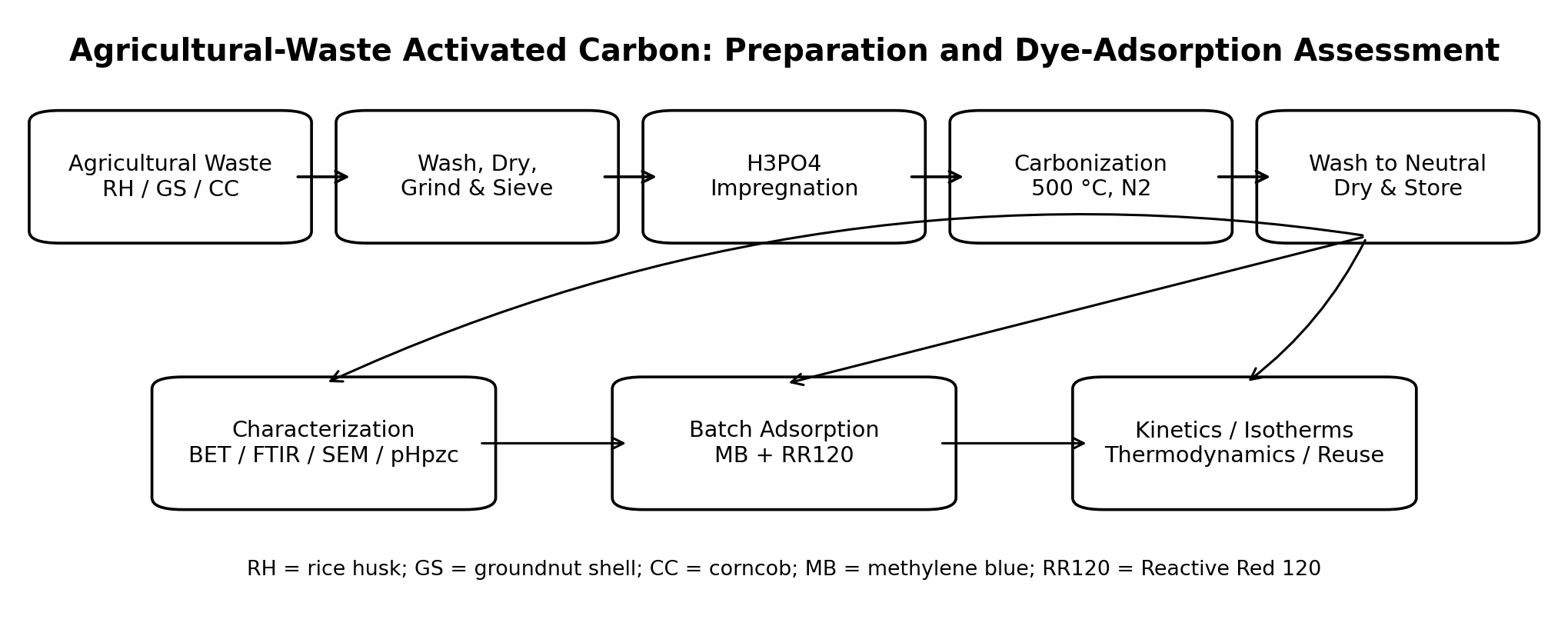
Agricultural residues are abundant lignocellulosic resources that can be converted into low-cost activated carbons for treatment of dye-contaminated water. This methodology paper presents a comparative assessment of activated carbon prepared from rice husk, groundnut shell, and corncob using a common phosphoric-acid activation and controlled carbonization protocol. The three carbons are characterized by Brunauer-Emmett-Teller surface-area analysis, pore-volume assessment, FTIR spectroscopy, scanning electron microscopy, proximate yield, and point of zero charge. Their adsorption performance is evaluated using methylene blue (MB) as a cationic model dye and Reactive Red 120 (RR120) as an anionic textile dye. Batch experiments investigate adsorbent dosage, initial dye concentration, pH, contact time, and temperature. Kinetic data are interpreted with pseudo-first-order and pseudo-second-order models, while equilibrium data are tested with Langmuir and Freundlich isotherms. Thermodynamic parameters and three-cycle regeneration are included to assess feasibility beyond a single equilibrium experiment. The study is guided by agricultural-waste activated-carbon literature showing that precursor chemistry, activation conditions, pore development, and surface functionality strongly affect dye uptake [1-6,9-16]. Illustrative results suggest that corncob- and groundnut-shell-derived carbons can develop higher accessible porosity than rice-husk carbon under identical conditions, while dye selectivity depends on solution pH and surface charge. The numerical values reported in the Results section are methodology examples rather than unperformed laboratory measurements. The framework provides a reproducible route for ranking agricultural residues as sustainable activated-carbon precursors for dye-removal applications.