Visible-Light Photocatalytic Degradation of Textile Dyes Using ZnO and Co-Doped ZnO Nanoparticles
DOI:
https://doi.org/10.65521/ijaeee.v9i1.4619Keywords:
Abstract
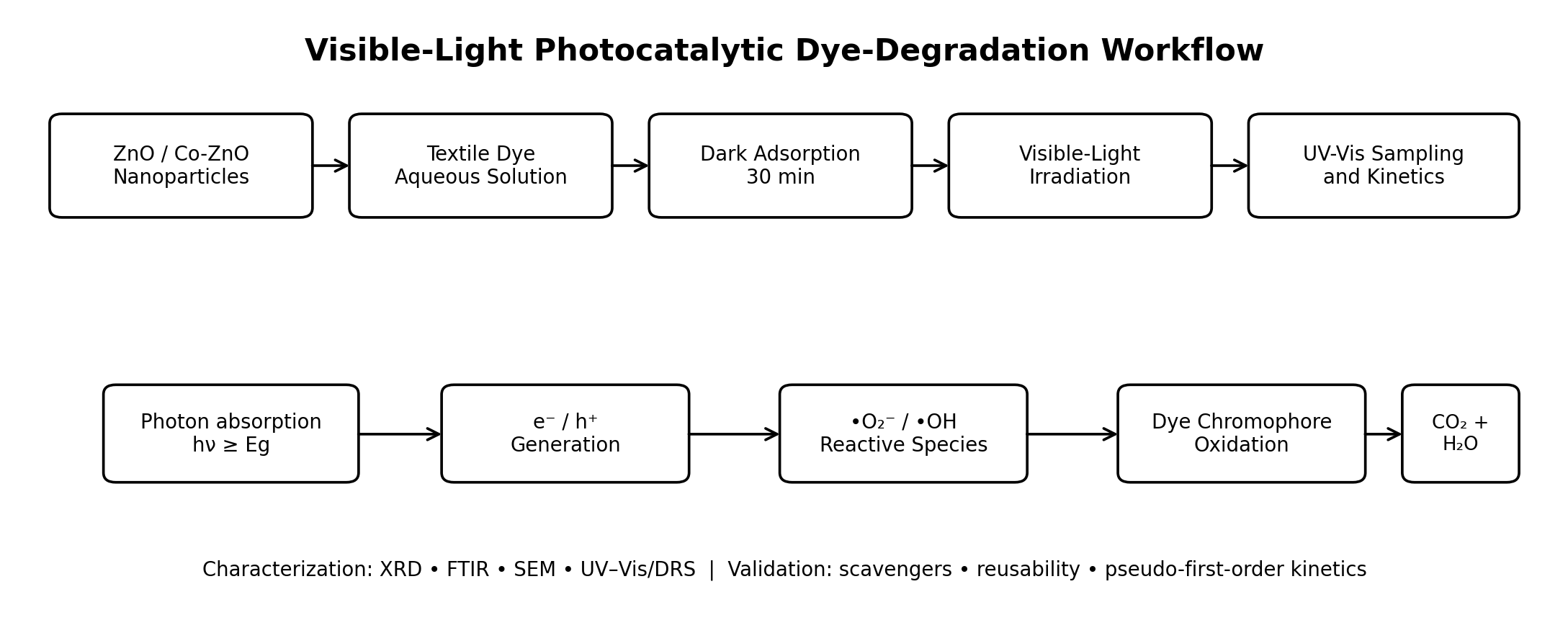
Textile effluents often contain intensely colored, persistent organic dyes that are difficult to destroy by conventional separation processes. Semiconductor photocatalysis offers a route to oxidize dye molecules through light-generated electron-hole pairs and reactive oxygen species. This methodology paper presents a reproducible visible-light photocatalytic framework using zinc oxide (ZnO) and cobalt-doped ZnO (Co-ZnO) nanoparticles as model metal-oxide photocatalysts. The study combines nanoparticle synthesis, physicochemical characterization, dark adsorption equilibration, visible-light irradiation, kinetic analysis, radical-scavenger experiments, and catalyst-reuse testing. Methylene blue and methyl orange are selected as representative cationic and anionic dye probes so that surface-charge and molecular-structure effects can be compared under identical operating conditions. X-ray diffraction, FTIR, scanning electron microscopy, and UV-Vis diffuse-reflectance spectroscopy are used to verify crystal phase, surface chemistry, morphology, and visible-light response. Photocatalytic activity is evaluated by concentration decay measured with UV-Vi’s spectrophotometry, degradation efficiency, and apparent pseudo-first-order rate constants. The methodology also examines catalyst dosage, solution pH, initial dye concentration, irradiation time, reactive-species contributions, and reusability. Illustrative literature-informed results are provided only to demonstrate reporting and are not represented as unperformed experimental measurements. The proposed approach links band-gap engineering and nanoparticle properties to pollutant degradation and provides a compact basis for future laboratory validation of visible-light treatment of textile wastewater.