Comparative Photocatalytic Degradation of Textile Dyes Using Modified TiO₂ Nanomaterials: A Kinetic Study
DOI:
https://doi.org/10.65521/ijaeee.v10i1.4589Keywords:
Abstract
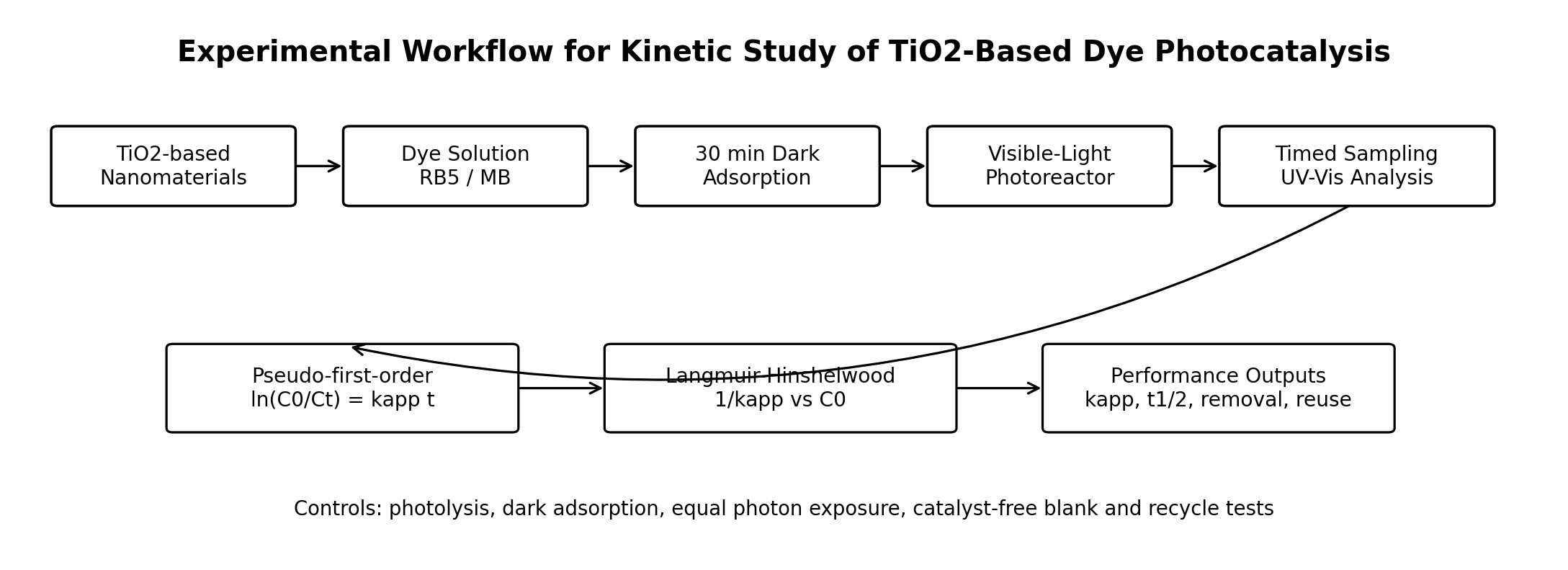
Textile dyes are chemically stable, intensely colored pollutants that can resist conventional biological treatment and reduce light penetration in receiving waters. Titanium dioxide (TiO₂) photocatalysis offers a destructive advanced-oxidation route in which light-generated electron-hole pairs form reactive oxygen species capable of attacking dye chromophores and, with sufficient treatment, mineralizing organic carbon. This methodology paper develops a kinetic framework for comparing three TiO₂-based nanomaterials—commercial P25 TiO₂, nitrogen-doped TiO₂ (N-TiO₂), and nickel-sulfur co-doped TiO₂ (Ni-S/TiO₂)—for degradation of Reactive Black 5 (RB5) and methylene blue (MB). The workflow combines catalyst synthesis/selection, XRD, FTIR, SEM/TEM and UV-Vis diffuse-reflectance characterization, batch photoreactor experiments, dark-adsorption controls, UV-Vis concentration monitoring, pseudo-first-order kinetics, Langmuir-Hinshelwood analysis, radical-scavenger tests, and catalyst-reuse assessment. Initial dye concentration, catalyst loading, pH, irradiation time and photon exposure are controlled systematically. The apparent first-order constant (kapp), half-life, percentage degradation, Langmuir-Hinshelwood kinetic parameters, and cycle-to-cycle activity retention are used for comparison. Representative numerical results are included only to demonstrate the intended analysis and are not presented as laboratory measurements. The proposed protocol provides a reproducible basis for connecting TiO₂ nanomaterial modification with dye adsorption, visible-light response and photocatalytic reaction kinetics.