Development and Evaluation of GO/TiO₂-Functionalized Thin-Film Nanocomposite Membranes for Advanced Water Purification
DOI:
https://doi.org/10.65521/ijaeee.v9i1.4620Keywords:
Abstract
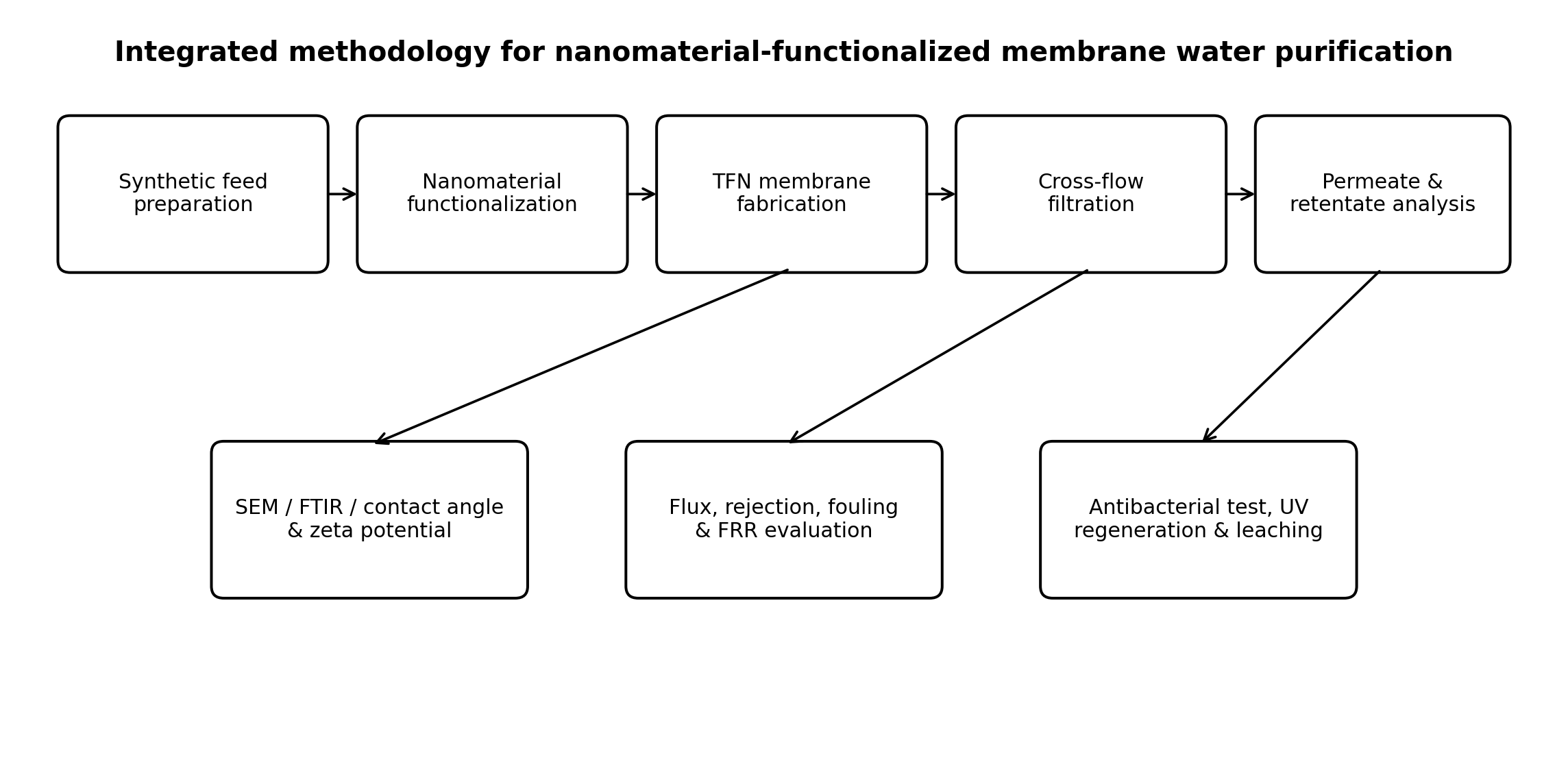
The increasing occurrence of dissolved salts, toxic metals, persistent organic contaminants, pathogenic microorganisms, and membrane-fouling constituents has created a need for water purification systems that combine high selectivity with low energy demand and regenerability. This methodology paper proposes an integrated experimental framework for evaluating functionalized nanomaterials in thin-film nanocomposite (TFN) membranes for advanced water purification. A conventional polyamide thin-film composite (TFC) membrane is used as the control and is compared with graphene oxide (GO), titanium dioxide (TiO₂), and hybrid GO/TiO₂-functionalized membranes. The protocol combines membrane fabrication by phase inversion and interfacial polymerization, physicochemical characterization, cross-flow filtration, contaminant rejection tests, antifouling assessment, antibacterial screening, photocatalytic regeneration, and nanoparticle-leaching analysis. Performance is quantified using water permeance, solute rejection, normalized flux decline, flux recovery ratio, log bacterial reduction, and membrane stability. To demonstrate the planned data-analysis pathway without representing unperformed experiments as real measurements, an explicitly labelled literature-informed illustrative dataset is included. The framework is designed to determine whether nanomaterial functionalization can improve water transport, separation, fouling resistance, and operational durability simultaneously. It also incorporates safety and scalability criteria, which are essential because nanomaterial release and manufacturing complexity can offset treatment benefits. The methodology provides a reproducible basis for laboratory studies of next-generation membrane systems for drinking-water polishing, industrial wastewater reuse, and desalination pretreatment.