Development of MnO₂/Reduced Graphene Oxide Nanocomposite Electrodes for High-Performance Energy Storage
DOI:
https://doi.org/10.65521/ijaeee.v11i1.4617Keywords:
Abstract
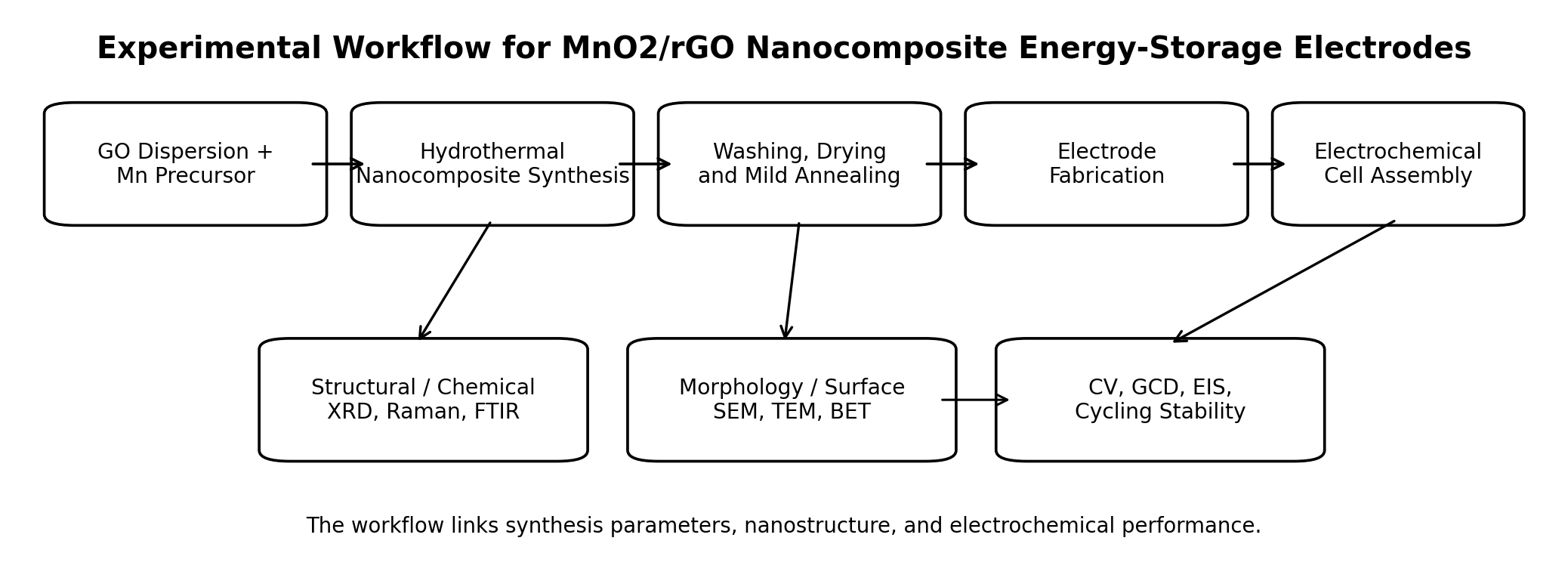
Advanced nanomaterials provide short ion-diffusion lengths, high interfacial area, tunable porosity, and improved charge-transfer pathways, making them attractive for high-rate electrochemical energy-storage devices. This methodology paper develops a reproducible experimental framework for synthesizing and evaluating a manganese-dioxide/reduced-graphene-oxide (MnO2/rGO) hybrid nanomaterial as a model pseudocapacitive electrode. The design combines a conductive carbon network with redox-active MnO2 in order to address the limited electronic conductivity of manganese oxide while preserving high accessible surface area. The proposed workflow includes solution-assisted hydrothermal synthesis, controlled washing and drying, electrode fabrication, structural and surface characterization, and electrochemical testing in an aqueous three-electrode cell. X-ray diffraction, Raman/FTIR spectroscopy, scanning/transmission electron microscopy, and BET analysis are used to connect phase, bonding, morphology, and porosity with electrochemical behavior. Cyclic voltammetry, galvanostatic charge-discharge, electrochemical impedance spectroscopy, rate-capability testing, and long-cycle stability are employed to quantify specific capacitance, energy/power response, resistance, and retention. Representative literature-informed outcomes are included only to demonstrate result reporting and are not presented as unperformed laboratory measurements. The methodology offers a compact route for correlating synthesis conditions with nanostructure and electrochemical performance and can be adapted to other oxide/carbon, MXene, or hybrid electrode systems.