Development of an IoT-Based Home Automation and Energy Management System
DOI:
https://doi.org/10.65521/ijaeee.v7i1.4576Keywords:
Abstract
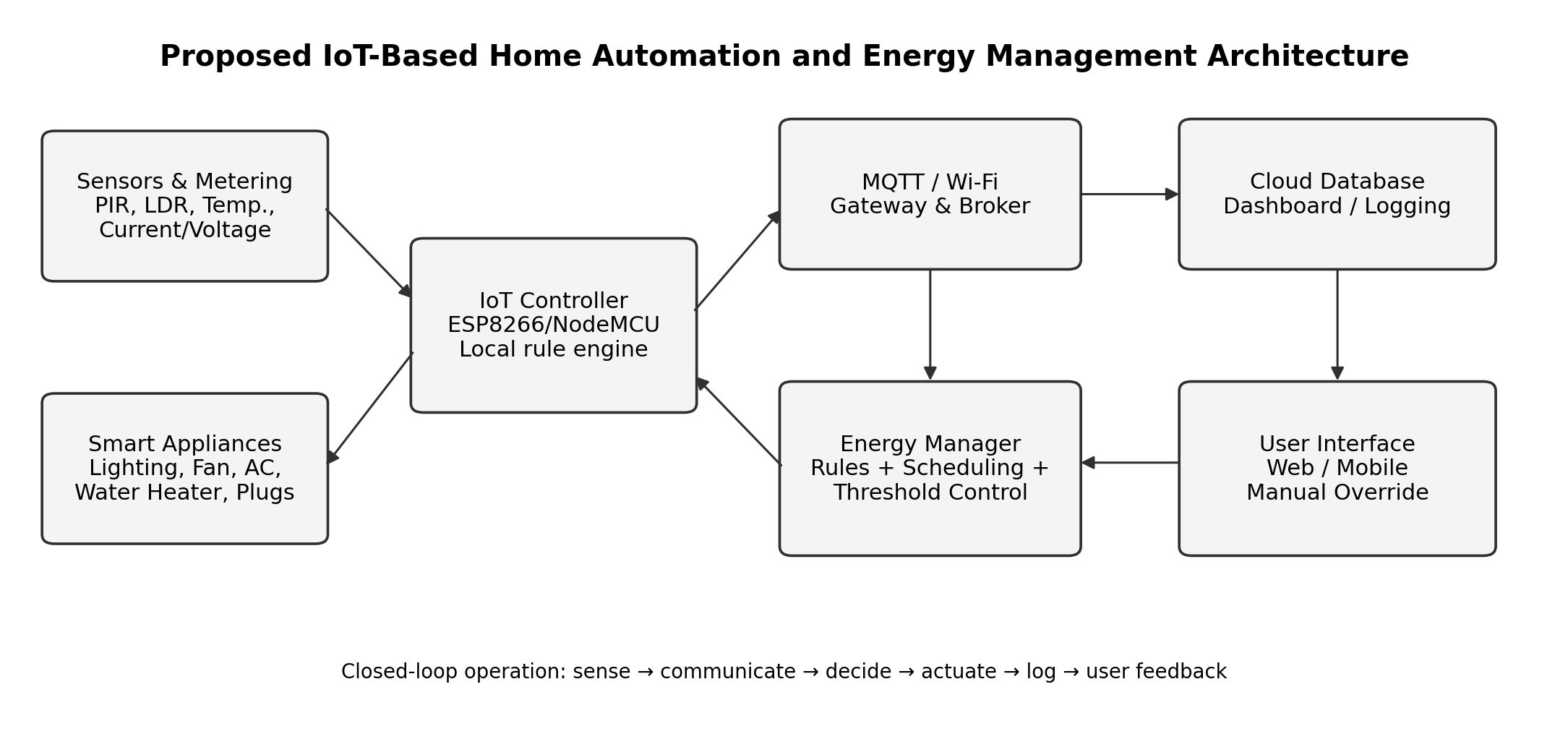
This paper presents a structured methodology for developing an Internet of Things (IoT)-based home automation and energy management system that combines appliance control, real-time electrical monitoring, user feedback, and energy-aware scheduling. The proposed architecture uses sensing and smart-metering nodes, a Wi-Fi-enabled embedded controller, MQTT-style publish/subscribe communication, a cloud or local database, a rule-based energy management layer, and a mobile/web interface. Unlike automation-only solutions, the methodology treats comfort, controllability, energy consumption, peak demand, communication reliability, and cyber-security as simultaneous design requirements. The development procedure is organized into requirement definition, hardware integration, communication design, control logic, data logging, security measures, and controlled validation. A reproducible 24-hour simulation/prototype profile is used to demonstrate the evaluation method; it indicates a reduction in daily energy use from 14.8 to 12.3 kWh, peak demand from 3.75 to 2.85 kW, and a relative electricity-cost index from 100 to 78.5, while maintaining user override capability. These values are illustrative validation outputs rather than claimed field measurements. The methodology offers a low-cost and extensible framework suitable for academic prototyping and future experimental deployment in residential buildings.