Design and Development of a GSM-Based Automatic Energy Meter Reading System
DOI:
https://doi.org/10.65521/ijaeee.v5i1.4591Keywords:
Abstract
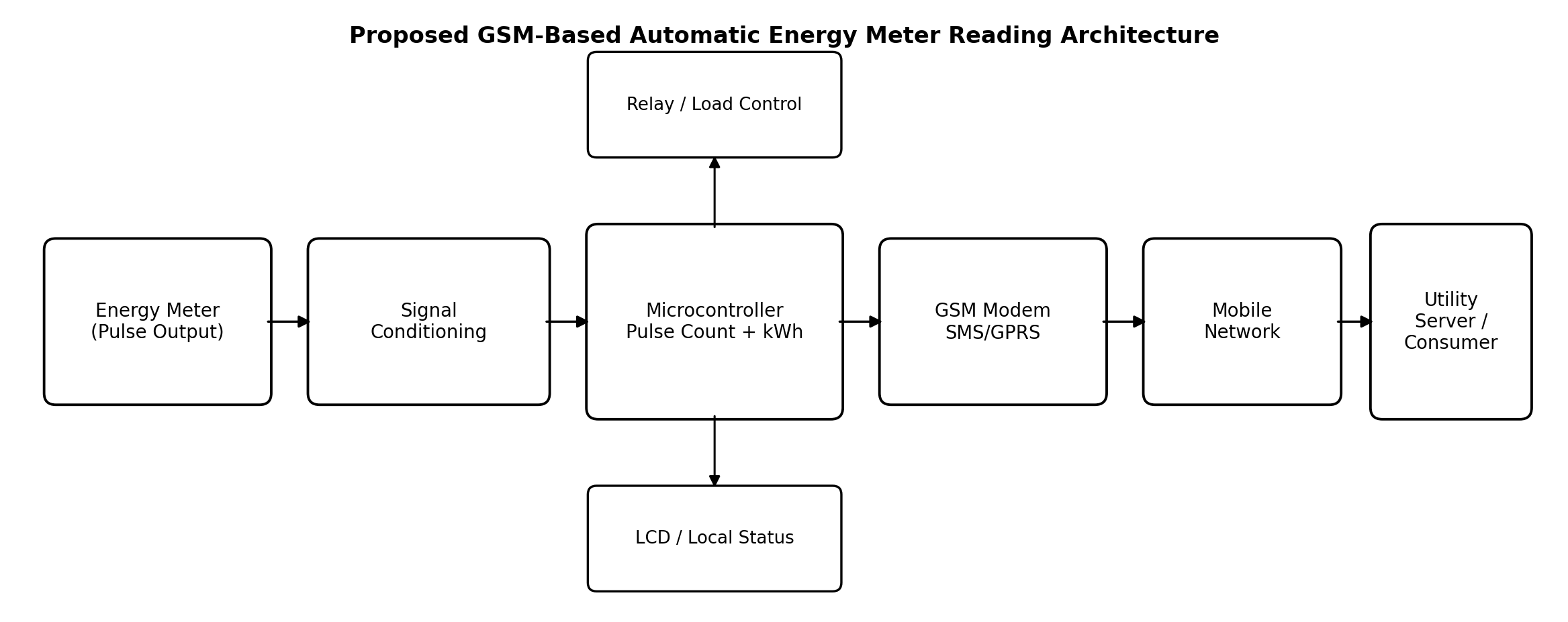
The conventional practice of collecting electricity-meter readings by sending personnel to consumer premises is labor intensive, slow, and vulnerable to transcription, access, and billing delays. This methodology paper presents the design and development framework for a Global System for Mobile Communications (GSM)-based Automatic Energy Meter Reading (AMR) system that converts meter pulses into accumulated energy, transmits consumption information by Short Message Service (SMS), and supports remote billing and optional load control. The proposed architecture contains an electronic energy meter with pulse output, signal-conditioning stage, microcontroller, local display, GSM modem, utility-side data endpoint, and relay interface. The methodology specifies pulse acquisition, energy calculation, message formatting, scheduled and on-demand reporting, command authentication, database update, and validation procedures. The design follows established AMR communication principles and GSM/SMS approaches reported in earlier research [1], [2], while incorporating low-cost microcontroller implementation practices demonstrated in smart-meter prototypes [5], [7], [8]. A representative validation framework evaluates energy-calculation error, SMS delivery time, reporting success, command response, and recovery after network interruption. The resulting design is intended as a practical transition from manual meter reading toward automated, transparent, and remotely accessible electricity-consumption monitoring. The approach is especially suitable where GSM coverage exists but broadband or dedicated metering infrastructure is limited.