Design and Implementation of a Smart Energy Meter Using GSM Communication Technology
DOI:
https://doi.org/10.65521/ijaeee.v7i1.4574Keywords:
Abstract
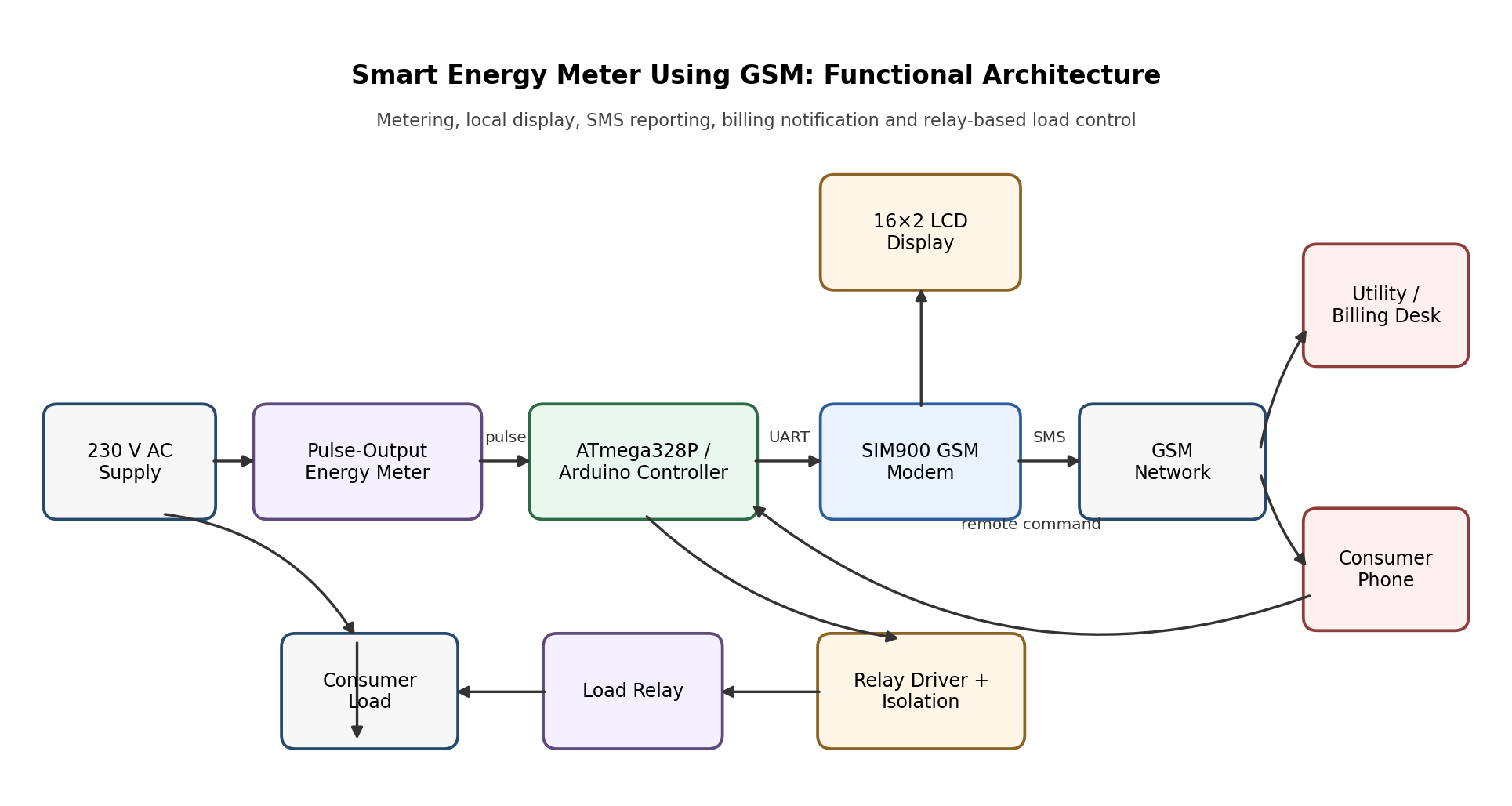
Conventional electricity-meter reading depends on periodic site visits, manual transcription and delayed billing, which can increase operating effort and postpone feedback to consumers. This methodology paper presents the design and implementation procedure for a low-cost single-phase smart energy meter that combines an electronic energy meter, an ATmega328P/Arduino-class controller, a GSM modem, a local liquid-crystal display and a relay interface. The controller counts calibrated energy pulses, converts them to kilowatt-hours, calculates the corresponding bill, displays the information locally and transmits consumption or warning messages through GSM short-message service. The same communication link can accept an authenticated control command for remote load disconnection or reconnection. The proposed methodology covers circuit architecture, embedded-software logic, calibration, GSM communication, billing computation and prototype validation. A representative acceptance dataset based on the stated test procedure shows an average absolute energy-measurement error of about 0.93% across five resistive and mixed-load trials, successful SMS reporting in 98 of 100 transmission attempts, and repeatable relay operation. The design therefore provides a practical framework for automatic meter reading, consumer notification and basic demand-side control while using communication hardware that was widely available before 2019. The paper is intentionally limited to literature published up to and including 2018.