Energy-Efficient Multilevel Inverter Design for Renewable Energy Applications
DOI:
https://doi.org/10.65521/ijaeee.v5i1.4585Keywords:
Abstract
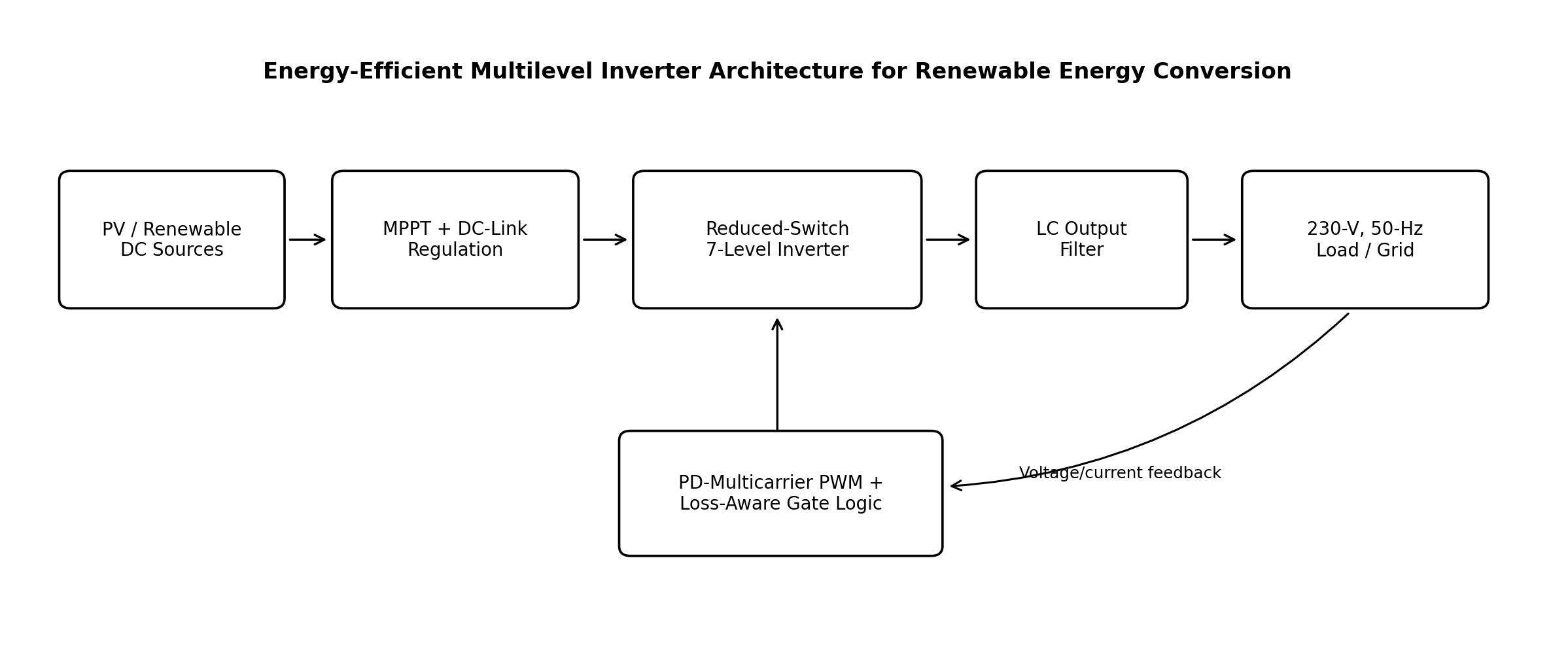
The increasing penetration of photovoltaic and other distributed renewable-energy sources requires power electronic interfaces that combine high conversion efficiency, low harmonic distortion, modularity, and acceptable semiconductor stress. This methodology paper develops a simulation-oriented design framework for an energy-efficient single-phase seven-level inverter intended for a 1 kW renewable-energy interface. The framework uses a reduced-switch multilevel structure, regulated isolated DC links, phase-disposition multicarrier pulse-width modulation, and a loss-aware switching strategy. The design objective is to minimize the combined conduction and switching losses while maintaining a near-sinusoidal 230 V, 50 Hz output and low total harmonic distortion (THD). A step-by-step procedure is given for source sizing, topology selection, switching-state definition, modulation design, loss calculation, and performance evaluation. The proposed configuration is benchmarked against a two-level voltage-source inverter and a conventional seven-level cascaded H-bridge. Under the defined simulation assumptions, the reduced-switch design uses eight controlled switches, achieves an estimated full-load efficiency of 96.3%, limits pre-filter voltage THD to 3.7%, and reduces total semiconductor loss to 38.8 W. The study demonstrates that multilevel voltage synthesis and device-count reduction can be combined to improve renewable-energy conversion efficiency without sacrificing waveform quality. The presented procedure is suitable as a reproducible methodology for MATLAB/Simulink or equivalent power-electronics simulation platforms, with hardware validation recommended as the next stage.