High-Efficiency Nine-Level Asymmetrical Cascaded H-Bridge Inverter for Renewable Energy Integration
DOI:
https://doi.org/10.65521/ijaeee.v13i2.4587Keywords:
Abstract
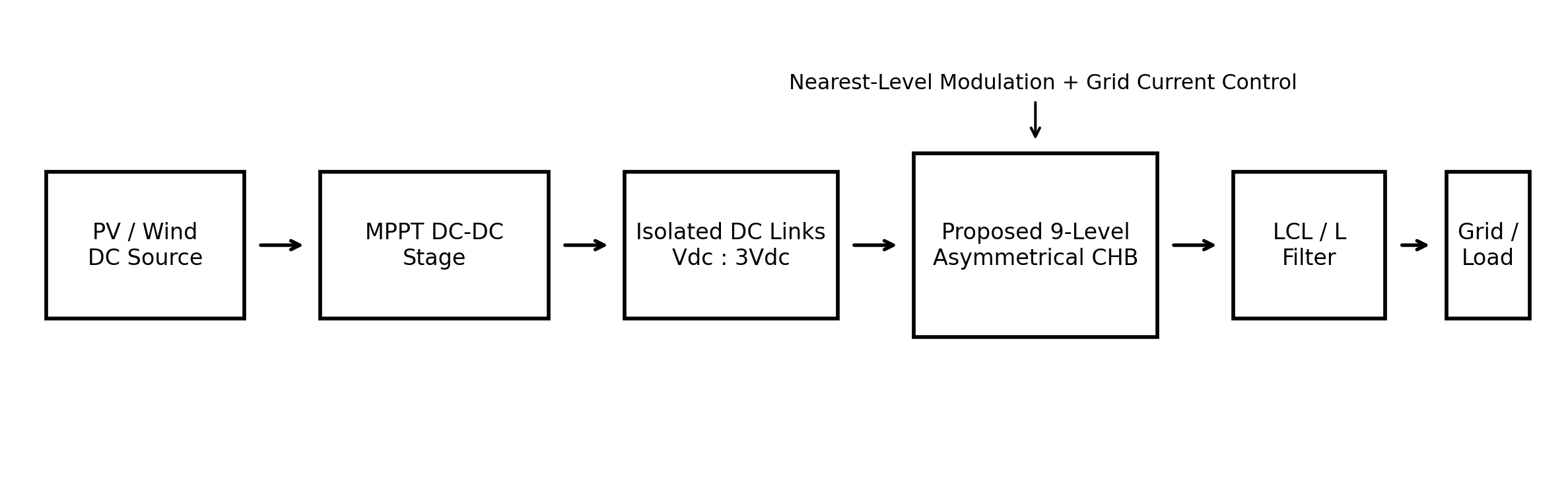
The rapid penetration of photovoltaic, wind, and hybrid distributed energy resources requires compact power-electronic interfaces capable of high efficiency, low harmonic distortion, and reliable grid synchronization. This paper develops a methodology for a high-efficiency nine-level asymmetrical cascaded H-bridge (ACHB) inverter intended for renewable-energy integration. Two isolated dc links are selected in a 1:3 voltage ratio so that only two H-bridge cells, eight active switches, and two dc sources synthesize nine output voltage levels (−4Vdc to +4Vdc). Nearest-level modulation is used to limit switching transitions and consequently reduce dynamic semiconductor loss, while an output filter and synchronous-reference-frame current controller are included for grid connection. The study combines topology synthesis, switching-state derivation, harmonic analysis, device-stress assessment, and a simplified conduction/switching-loss model. A reproducible numerical waveform model is used to quantify voltage total harmonic distortion (THD), filtered current THD, fundamental voltage, and estimated conversion efficiency. For the selected 400-V peak design, the unfiltered nine-level staircase gives an analytical voltage THD of 8.71%, whereas a 15-mH interface inductance reduces the calculated load-current THD to approximately 2.58%. With 25 W aggregate semiconductor and passive loss at 1 kW output, the estimated inverter-stage efficiency is 97.56%. The proposed approach therefore offers a practical balance between device count, waveform quality, and conversion efficiency for small and medium renewable-energy systems, while remaining modular enough for higher voltage and power ratings