Performance Evaluation of a Reduced-Switch Asymmetric Seven-Level Inverter for Renewable Energy Systems
DOI:
https://doi.org/10.65521/ijaeee.v6i1.4572Keywords:
Abstract
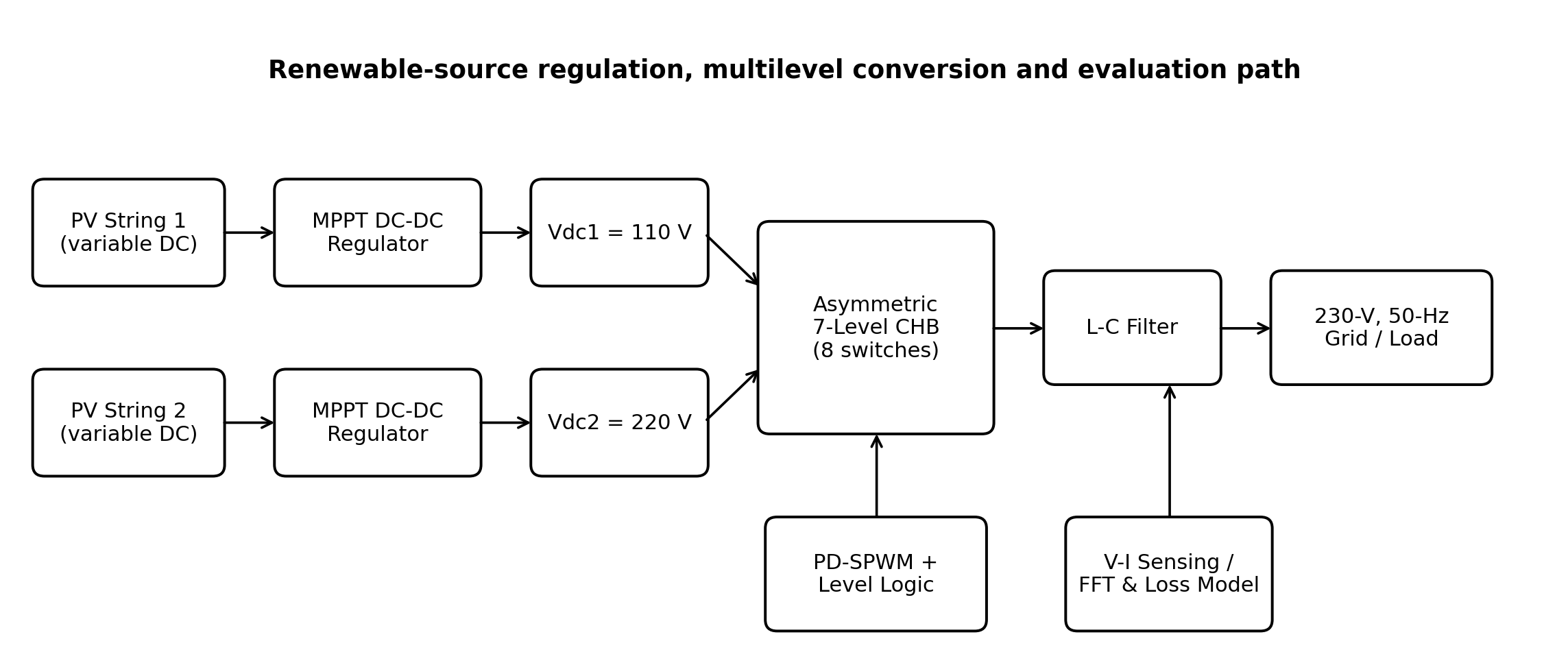
Renewable-energy conversion requires inverter topologies that can provide high-quality AC output while limiting semiconductor count, switching losses, and implementation complexity. This study presents a reduced-switch asymmetric seven-level inverter based on two cascaded H-bridge cells supplied by regulated DC-link voltages in a 1:2 ratio. The proposed configuration uses 110 V and 220 V isolated DC links to generate seven output voltage levels from −330 V to +330 V using eight active switches and two H-bridge cells. In comparison, a conventional symmetric seven-level cascaded H-bridge requires three cells and twelve active switches. The methodology integrates regulated renewable-source DC links, phase-disposition sinusoidal pulse-width modulation, an L-C output filter, FFT-based harmonic analysis, and semiconductor conduction and switching-loss estimation. Performance is evaluated under 25%, 50%, 75%, and 100% loading and under renewable-input conditions corresponding to 600–1000 W/m² while maintaining the required DC-link ratio. The representative simulation results show that the proposed inverter achieves approximately 96.5% full-load efficiency and 2.1% filtered current total harmonic distortion. The configuration also reduces the active-switch and gate-driver count by 33.3% relative to the symmetric seven-level baseline while maintaining comparable output-waveform quality. The main design trade-off is the requirement for unequal semiconductor voltage ratings in the two H-bridge cells. The results indicate that the asymmetric reduced-switch configuration provides a compact and energy-efficient interface for small photovoltaic, fuel-cell, battery-assisted, and hybrid renewable-energy systems.