Design and Performance Optimization of Grid-Connected Solar Photovoltaic Systems Using Advanced MPPT Techniques
DOI:
https://doi.org/10.65521/ijaeee.v13i2.4582Keywords:
Abstract
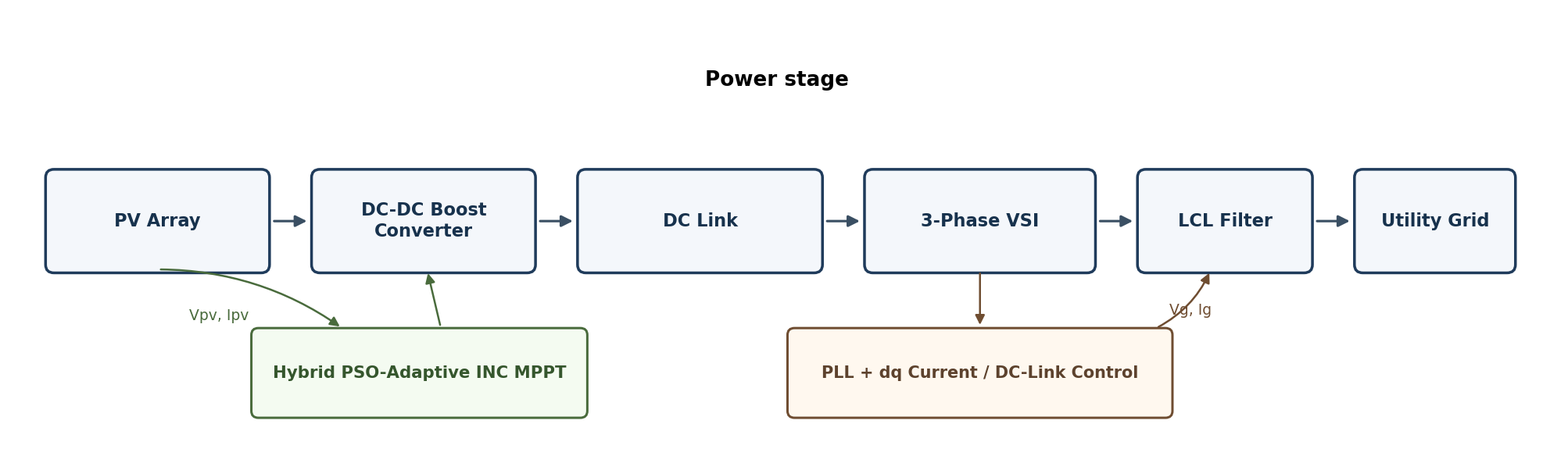
Grid-connected photovoltaic (PV) generation requires continuous maximum power point tracking (MPPT) because the PV current-voltage characteristic changes nonlinearly with irradiance, temperature, mismatch and partial shading. This methodology paper develops a reproducible design and performance-optimization framework for a two-stage grid-connected PV system and proposes a hybrid particle-swarm-optimization/adaptive incremental-conductance (H-PSO-AINC) MPPT strategy. The method combines global search during multimodal power-voltage conditions with a low-ripple local tracker during uniform or slowly varying conditions. A boost converter regulates the PV operating point, while a three-phase voltage-source inverter uses phase-locked-loop synchronization, DC-link control and synchronous-reference-frame current regulation for unity-power-factor grid injection. Performance is evaluated against perturb-and-observe (P&O), fixed-step incremental conductance (INC) and conventional PSO using tracking efficiency, settling time, steady-state ripple, global-MPP success rate, DC-link deviation and grid-current total harmonic distortion. A representative 100-kWp simulation benchmark indicates that the proposed hybrid method can preserve rapid convergence under irradiance transients and avoid local maxima during partial shading while maintaining low steady-state oscillation. The framework is intended as a compact methodology for MATLAB/Simulink or equivalent real-time implementation and is grounded in MPPT literature published through 2024.