Design and Control of a Grid-Connected Wind Energy Conversion System
DOI:
https://doi.org/10.65521/ijaeee.v6i1.4570Keywords:
Abstract
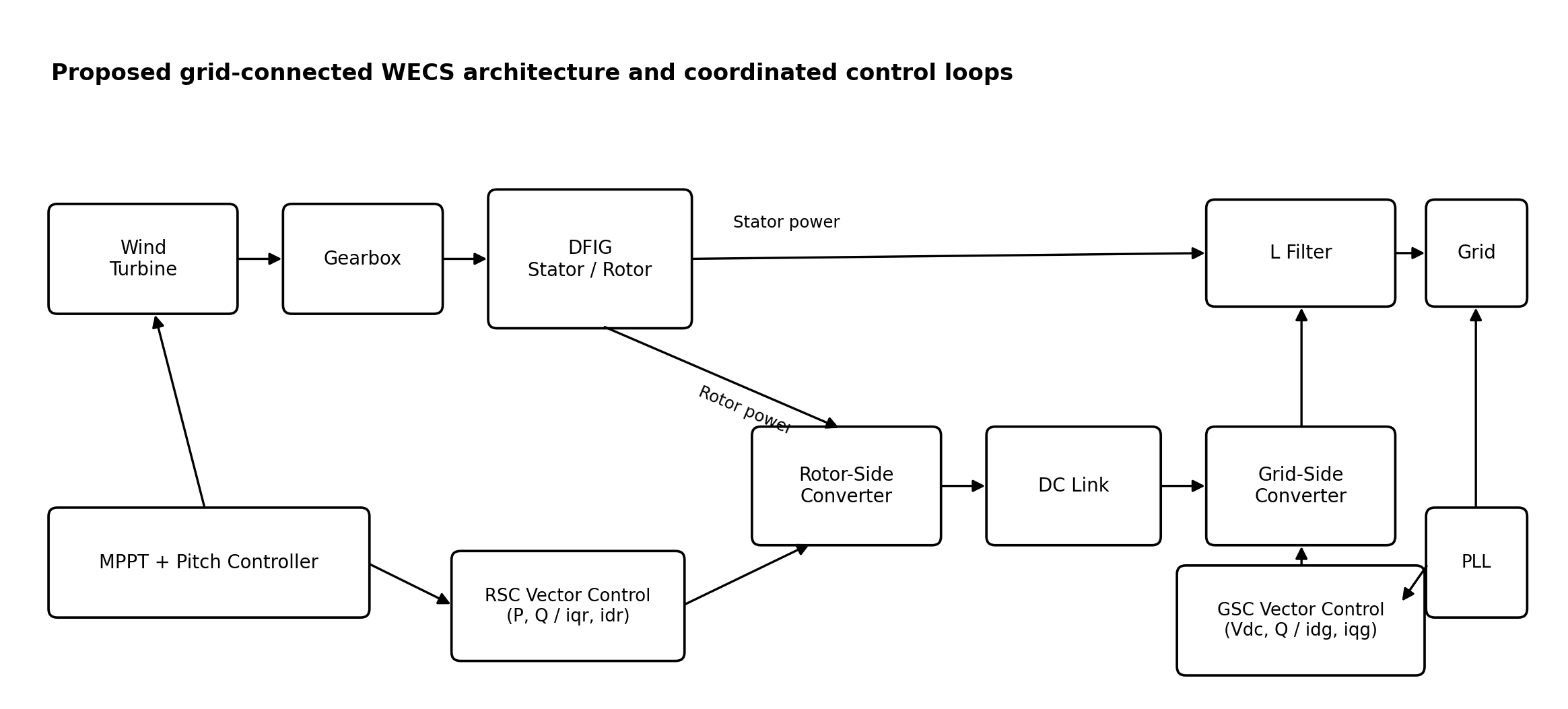
This methodology paper develops a coordinated design and control framework for a variable-speed, grid-connected wind energy conversion system (WECS) based on a doubly fed induction generator (DFIG). The study integrates aerodynamic power extraction, maximum power point tracking (MPPT), rotor-side vector control, grid-side converter control, DC-link regulation, phase-locked-loop synchronization, reactive-power management, and pitch limitation above rated wind speed. A 2 MW reference turbine is used to make the procedure reproducible. The electrical model is formulated in a synchronous dq reference frame, while the turbine is represented by the standard power-coefficient relationship between wind speed, tip-speed ratio, pitch angle, and captured mechanical power. The control objective is to maximize energy capture below rated speed, regulate stator active and reactive power independently, maintain a stable DC-link voltage, and inject sinusoidal current into the utility grid at near-unity power factor. A numerical evaluation of the resulting control architecture shows a smooth cubic MPPT region followed by rated-power limitation and stable grid-side variables. The paper is intended as a compact methodology template that can be implemented in MATLAB/Simulink or an equivalent dynamic simulation environment and validated using the parameter set and performance indices reported here.