Design and Performance Analysis of Grid-Connected Solar Photovoltaic Systems with MPPT Control Techniques
DOI:
https://doi.org/10.65521/ijaeee.v8i1.4606Keywords:
Abstract
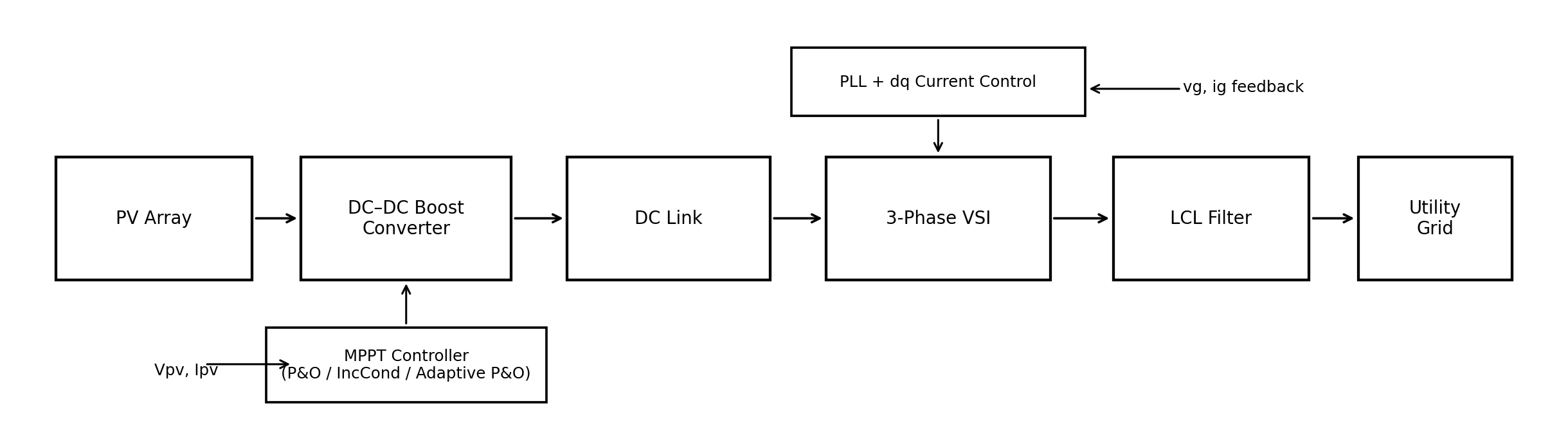
Grid-connected photovoltaic (PV) generation requires coordinated energy extraction and grid-interface control because the PV operating point changes continuously with irradiance and temperature. This methodology paper presents a reproducible design and evaluation framework for a two-stage grid-connected PV system using a DC–DC boost converter, maximum power point tracking (MPPT), a regulated DC link, and a three-phase voltage-source inverter. Three MPPT strategies—perturb and observe (P&O), incremental conductance (IncCond), and adaptive P&O—are compared under identical irradiance transitions. The PV array is represented by a single-diode model, while the inverter is synchronized to the utility by a phase-locked loop and controlled in the synchronous dq frame. Performance is evaluated using MPPT tracking efficiency, transient settling time, steady-state oscillation, DC-link voltage deviation, inverter current total harmonic distortion (THD), and grid power factor. A representative design-study benchmark shows that adaptive P&O and IncCond reduce tracking delay and oscillation relative to fixed-step P&O, while a well-tuned grid-current controller maintains low THD and near-unity power factor. The procedure is intended as a compact methodology that can be implemented in MATLAB/Simulink or an equivalent power-electronics simulation platform and subsequently validated experimentally