Power Quality Improvement in Distribution Networks Using DSTATCOM Technology
DOI:
https://doi.org/10.65521/ijaeee.v7i1.4575Keywords:
Abstract
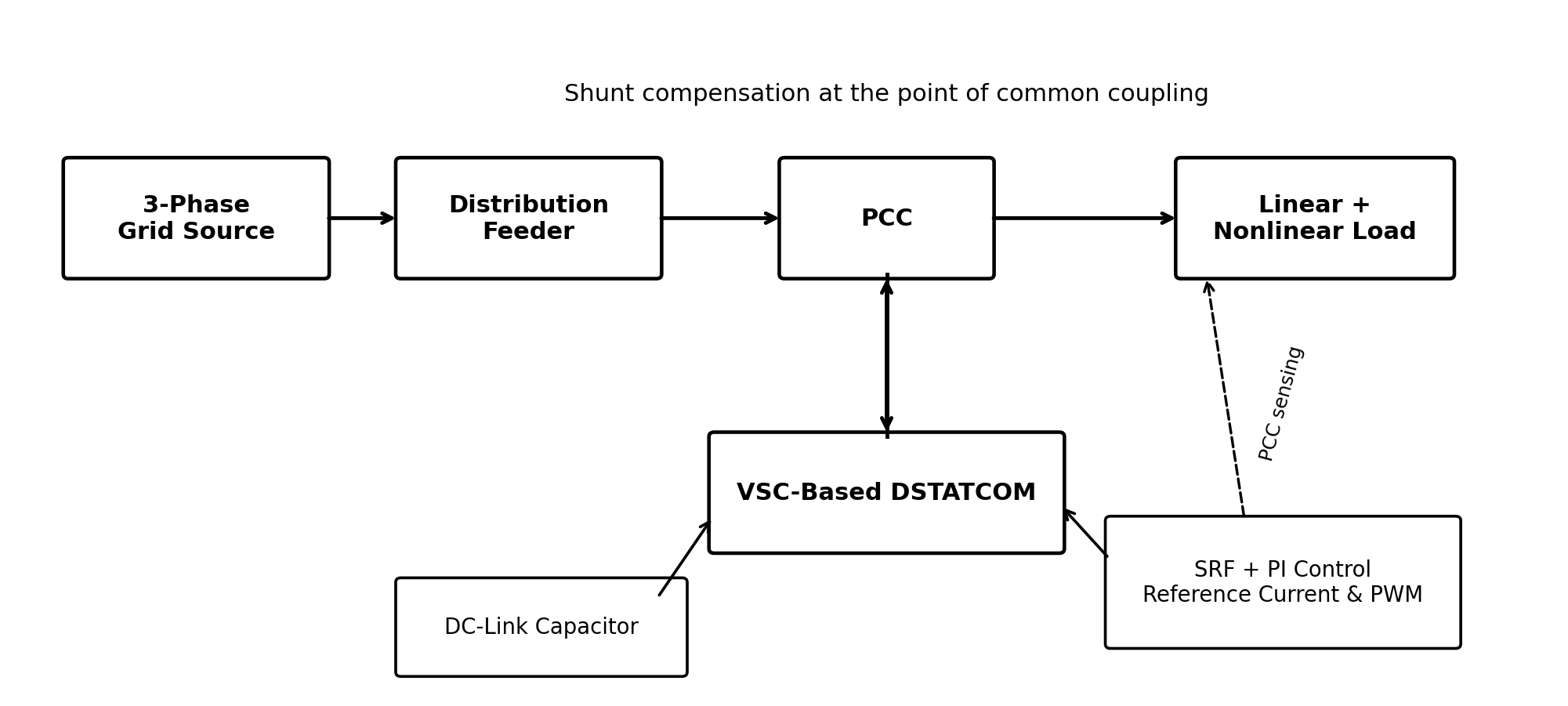
The increasing use of nonlinear electronic loads, induction motors, distributed generation and converter-interfaced equipment has intensified voltage sag, swell, current harmonics, reactive-power demand and load-unbalance problems in distribution networks. This methodology paper develops a systematic framework for improving distribution-level power quality using a shunt-connected Distribution Static Compensator (DSTATCOM). The proposed system uses a voltage-source converter, dc-link capacitor, coupling inductor and synchronous-reference-frame (SRF) controller with proportional-integral regulation of the dc-link voltage. A MATLAB/Simulink-type test network is formulated to examine balanced, unbalanced and nonlinear loading together with programmed voltage sag and swell events. Performance is evaluated using PCC voltage regulation, source-current total harmonic distortion (THD), power factor, reactive-power exchange and voltage unbalance. The representative simulation study indicates that the DSTATCOM can restore the PCC voltage close to 1.0 p.u., reduce source-current THD from 17.8% to 3.6%, improve power factor from 0.78 to 0.99, and strongly reduce reactive-power demand from the upstream grid. The methodology is consistent with the established DSTATCOM literature and is intended as a reproducible procedure for comparative power-quality studies rather than as a claim of laboratory measurement