AI-Based Fault Detection and Predictive Maintenance in Smart Electrical Distribution Networks
DOI:
https://doi.org/10.65521/ijaeee.v13i2.4580Keywords:
Abstract
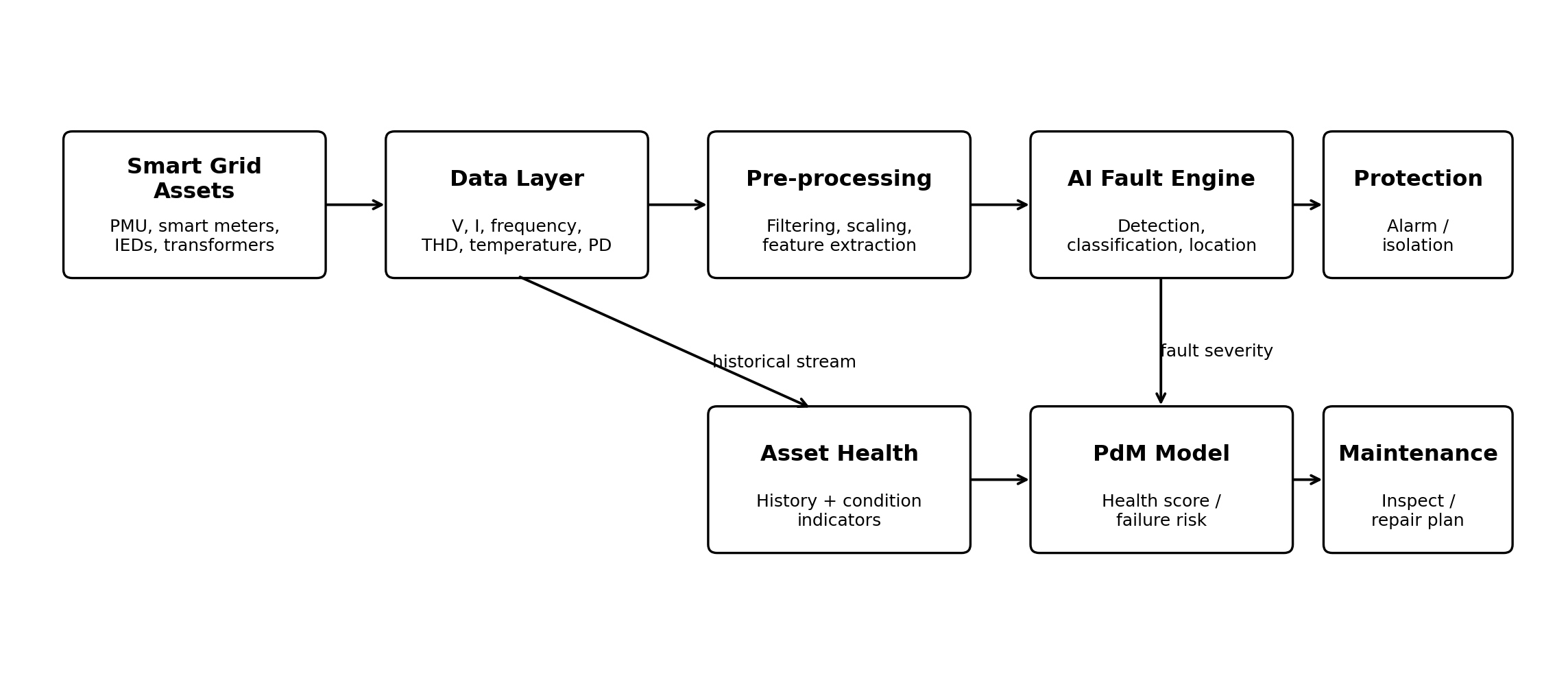
Smart electrical distribution networks contain distributed energy resources, power-electronic interfaces, smart meters, phasor measurement units, intelligent electronic devices, and communication links that generate large volumes of operating data. These data enable a shift from conventional threshold-based protection and time-based maintenance toward artificial-intelligence (AI) assisted fault diagnosis and predictive maintenance. This paper proposes a compact methodology for integrating real-time fault detection, multi-class fault classification, fault localization support, and asset-health prediction in a unified distribution-network workflow. Voltage sag, current magnitude, sequence components, harmonic distortion, temperature, partial-discharge indicators, switching history, loading, and ambient conditions are used as condition features. The methodology combines signal preprocessing with supervised machine-learning models for fault recognition and a regression-based health model for maintenance prioritization. A proof-of-concept synthetic experiment representing healthy operation and single-line-to-ground, line-to-line, double-line-to-ground, and three-phase faults is used to evaluate the analytical pipeline. Among the tested classifiers, the radial-basis-function support-vector machine achieved 94.8% test accuracy and 0.948 macro F1-score, while a random-forest health model achieved a mean absolute error of 3.54 health-index points and R² of 0.948. The results indicate that a coordinated AI layer can improve diagnostic consistency, reduce unnecessary maintenance actions, and support faster condition-based decisions. The paper also identifies practical requirements related to data quality, class imbalance, explainability, cybersecurity, model drift, and utility-scale validation.