Fault Detection and Protection Coordination in Electrical Transmission Networks
DOI:
https://doi.org/10.65521/ijaeee.v4i1.4567Keywords:
Abstract
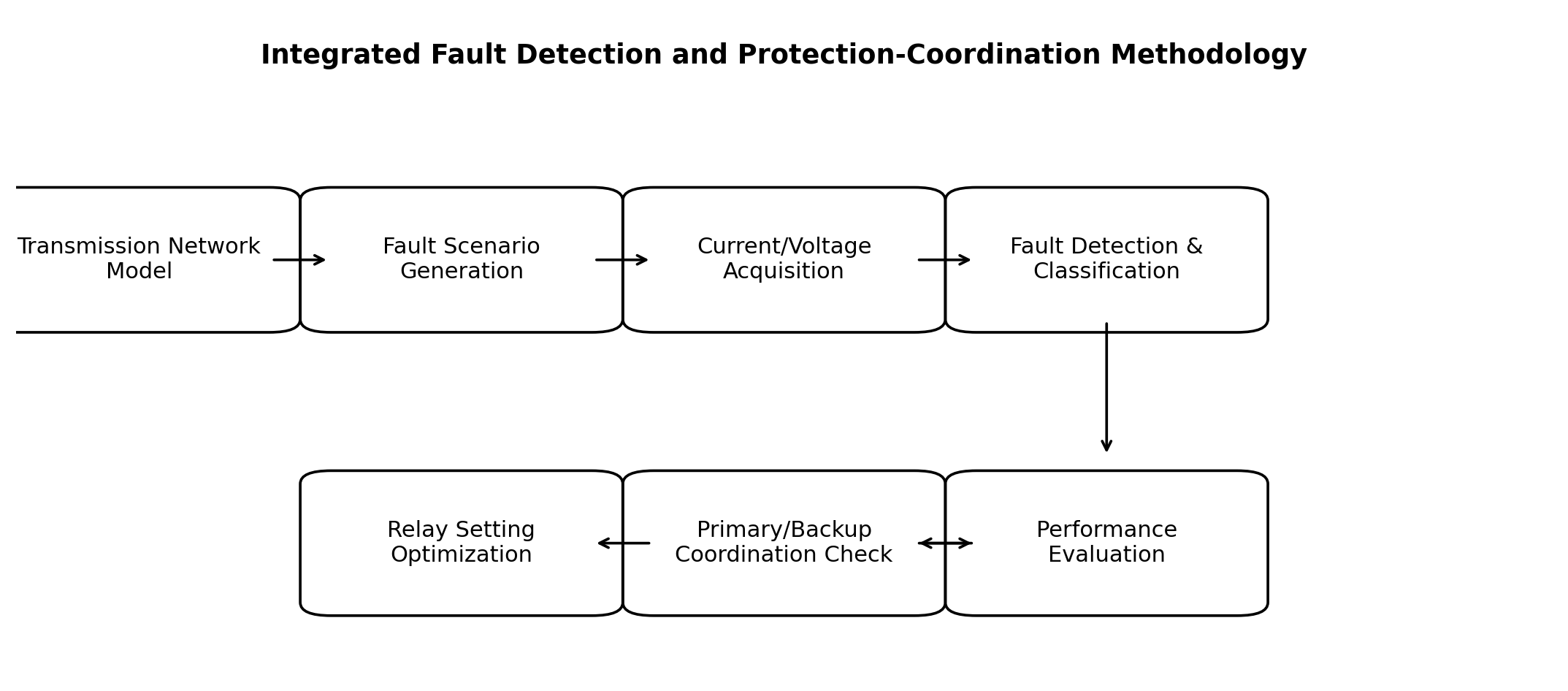
Reliable transmission-network protection requires two functions to operate together: rapid identification of the faulted condition and selective coordination of primary and backup relays. This methodology paper develops an integrated simulation framework for fault detection, fault-type classification, and directional-overcurrent relay coordination in an interconnected electrical transmission network. Three-phase current and voltage signals are sampled during normal and faulted states; normalized phase-energy changes and sequence-current information are used to detect and classify single-line-to-ground, line-to-line, double-line-to-ground, and three-phase faults. Protection coordination is formulated as a constrained optimization problem in which relay time-multiplier settings are selected to minimize operating time while preserving a minimum coordination time interval between primary and backup devices. A representative 220-kV network is examined under variations in fault location, fault resistance, loading, and inception angle. Illustrative simulation results show 99.4% fault classification accuracy across 3,150 synthetic test cases, an average detection time of 7.2 ms, and coordinated primary-backup relay margins of approximately 0.33–0.38 s. The framework demonstrates how signal-based fault diagnosis and optimized relay settings can be combined to improve speed, selectivity, and dependability without violating backup-protection requirements.