
Power Theft Detection for Shared Electricity Lines
DOI:
https://doi.org/10.65521/ijaeee.v14i2.1701Keywords:
Abstract
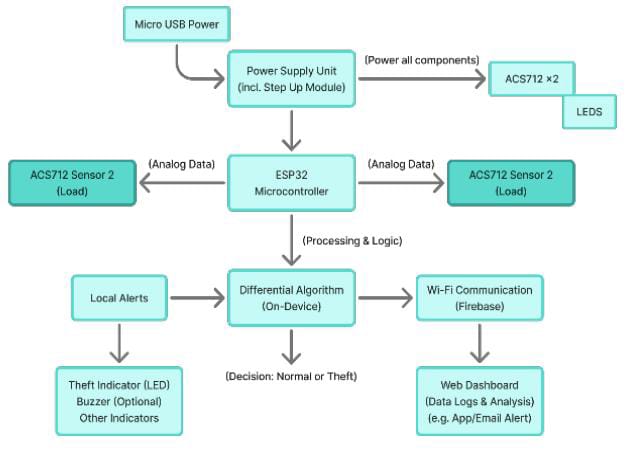
Electricity theft on shared distribution lines contributes significantly to non-technical losses and grid instability, while many existing countermeasures remain reactive, costly, or difficult to scale [1]. This work presents a low-cost IoT-based system that performs real-time theft detection by comparing source and load currents using dual ACS712 sensors interfaced with an ESP32 microcontroller [4], [5]. Calibrated sensor readings are formatted as JSON and streamed to Firebase, where an on-device differential algorithm applies time-windowed thresholding to suppress transient variations before flagging anomalies [3], [6]. When sustained discrepancies beyond the calibrated tolerance are detected, the system triggers a local buzzer alert and issues cloud-based notifications, while a responsive web dashboard logs events for operator analysis and auditing [7].
Designed for shared residential, industrial, and rural feeders, the prototype emphasizes deployability, affordability, and scalability through built-in Wi-Fi and lightweight web architecture [2], [8]. Experimental validation demonstrates continuous monitoring, instant alerting, and reliable anomaly detection, aligning with recent IoT-driven power theft detection frameworks while enhancing cost efficiency and real-time responsiveness [5], [9]. By unifying edge sensing, on-device inference, and cloud visualization, the system offers a practical, scalable, and secure pathway for utilities and communities to curb losses and strengthen smart-grid integration under constrained budgets [10].
The contributions include an end-to-end demonstration of real-time theft detection on shared lines using edge computing, a practical threshold-based algorithm, and a cloud-integrated visualization (building on prior IoT meter-monitoring frameworks). The prototype is designed for easy deployment across residential, rural, or industrial feeders, emphasizing affordability (ESP32 and ACS712 cost under $10) and scalability (wireless connectivity and lightweight web UI). Experimental validation confirms continuous anomaly logging and prompt alerts with high detection reliability. By unifying edge sensing with cloud analytics, the system offers utilities a practical, low-cost tool to curb non-technical losses and improve smart-grid visibility.
Downloads
Published
How to Cite
Issue
Section
License

This work is licensed under a Creative Commons Attribution-NoDerivatives 4.0 International License.
